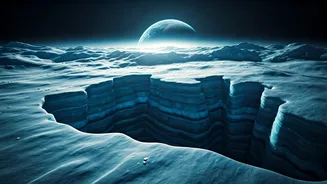







Ancient Ice Unveiled
The frozen water found at the Moon's poles isn't a recent phenomenon; it's a remarkably ancient reserve that has been steadily accumulating for approximately
1.5 billion years. Scientists have recently pinpointed this extended timeline through the analysis of novel data, a discovery that holds significant implications for upcoming lunar expeditions and the ambitious prospect of establishing human settlements on our celestial neighbor. This extended history suggests a continuous process of ice formation and preservation, hinting at the Moon's dynamic past and its potential as a resource-rich destination for humanity's future space endeavors.
Shadows and Ice Formation
New research indicates a direct correlation between the age of lunar shadows and the quantity of exposed ice they contain. By examining ultraviolet light data, scientists have observed that more recent shadowed regions tend to harbor greater amounts of readily accessible ice compared to older shadowed areas. This observation suggests a fascinating cyclical process influenced by subtle shifts in the Moon's axial tilt over eons. As the Moon's orientation has changed, new areas have fallen into perpetual shadow, capturing and preserving more ice, while older shadowed regions may have experienced sublimation or other forms of ice loss. Understanding these dynamics is paramount for planning effective missions aimed at utilizing this ancient ice as a critical resource for water, breathable oxygen, and even propellants, paving the way for sustained human presence beyond Earth.