




Contact Restored
After a puzzling absence spanning February and into March of 2026, communication lines have been reconnected with ESA's groundbreaking Proba-3 spacecraft.
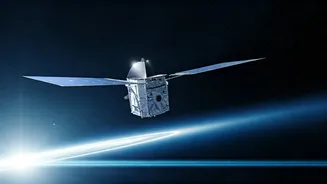
Mission control teams were relieved to confirm that the spacecraft is currently operating in a 'safe mode.' This state indicates that its essential systems are stable, and engineers are diligently performing comprehensive health checks to ascertain the full status of its complex onboard instruments and operational capabilities. The successful reacquisition of contact marks a significant milestone in ensuring the continuation of its vital scientific mission, which involves unprecedented observations of the Sun's elusive corona.
Twin Satellites' Mission
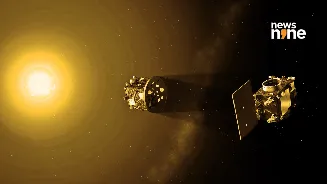
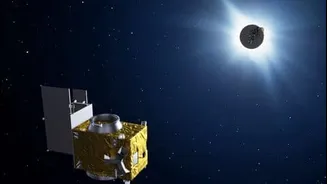
The Proba-3 mission is a truly unique endeavor, employing not one, but two meticulously synchronized satellites that fly in formation approximately 150 meters apart. Their ingenious design allows them to collaboratively generate artificial solar eclipses, a crucial maneuver enabling scientists to study the faint outer atmosphere of the Sun, known as the corona. For roughly a month, during its period of silence, the spacecraft autonomously oriented its solar panels towards the Sun. This strategic positioning was vital for generating the necessary power to sustain its electronic functions and replenish its onboard battery while in the safe mode, a testament to its robust autonomous capabilities.
Unraveling Solar Mysteries
The primary objective of the Proba-3 mission is to unlock some of the Sun's most persistent enigmas, particularly the phenomenon of coronal heating. By effectively blocking the Sun's blinding glare for extended periods, Proba-3 creates ideal conditions for researchers to investigate what causes the Sun's corona to be millions of degrees hotter than its visible surface. Furthermore, this mission aims to pinpoint the origins of solar storms, events that have a profound impact on space weather and can disrupt technological systems on Earth. Prior to its temporary communication lapse, the Proba-3 spacecraft had already successfully executed multiple artificial eclipses and accumulated valuable hours of observational data concerning the solar corona, laying crucial groundwork for future scientific breakthroughs.