




New Satellite Vision
A significant leap forward in space technology is on the horizon, thanks to a startup founded by a seasoned professional from a prominent aerospace company.
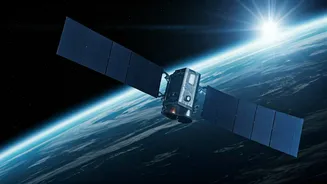
This venture is focused on reimagining satellite design by incorporating built-in thermal protection systems. The core innovation lies in engineering satellite structures that can withstand the intense heat generated during atmospheric reentry. This capability would allow satellites, along with their valuable scientific instruments or data payloads, to be brought back to Earth in a controlled and safe manner. Historically, the extreme conditions of reentry have made such returns prohibitively complex and costly for most non-human spaceflight missions. This new approach aims to dismantle that barrier, paving the way for a more sustainable and versatile space infrastructure.
Seed Funding Secured
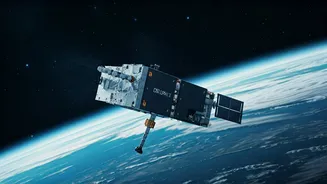
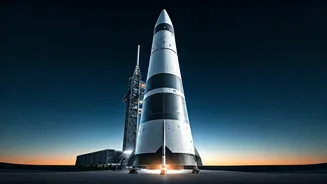
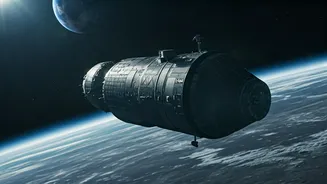
This ambitious endeavor has successfully secured substantial initial funding, amounting to $10 million in a seed funding round. The investment was spearheaded by a venture capital firm, with participation from a diverse group of other investors. These funds are earmarked for the critical design and initial construction phases of the company's flagship spacecraft, codenamed 'Delphi'. This demonstrator spacecraft is slated for a launch aboard a rocket from a leading space exploration company in the first quarter of 2027. The mission's primary objective is to rigorously test and validate the innovative reentry technology. It will carry hosted payloads and materials designed to endure the return journey, providing crucial data for future satellite development.
Reentry Hurdles
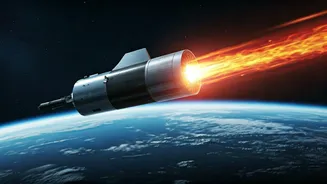
The process of re-entering Earth's atmosphere from the vacuum of space is an extraordinarily demanding engineering challenge. As a spacecraft plummets towards the planet at immense velocities, it encounters atmospheric friction, generating temperatures that can reach thousands of degrees Celsius. To survive this fiery descent, spacecraft must be equipped with specialized heat shielding materials capable of dissipating or withstanding this intense thermal energy. The addition of these protective systems often adds considerable weight and complexity, significantly increasing the overall cost of the mission. Consequently, the ability to safely return to Earth has largely been confined to crewed spacecraft designed for human survival, or more recently, to specialized capsules built by other emerging companies for the retrieval of scientific samples or limited cargo.
Pioneering Reentry Solutions
Several innovative companies are actively developing dedicated reentry capsules to address the growing need for sample and cargo return from space. One notable startup has successfully conducted multiple missions, achieving successful returns on the vast majority of its attempts. Another company is preparing to launch its reentry vehicle later this year, aiming to demonstrate its capabilities. These specialized capsules are designed to carry valuable scientific experiments or sensitive materials back to Earth, often at high speeds. While these efforts focus on returning specific payloads, the broader vision encompasses a future where entire satellite platforms can be brought back, fundamentally altering the economics and sustainability of space operations.
The Reusability Dream
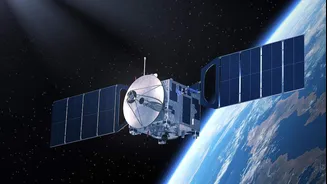
The current generation of satellites, including those used for communication and Earth observation, typically have a finite operational lifespan, usually ranging from five to ten years. This limitation is often dictated by factors such as component degradation, the depletion of onboard propellant, or the rapid pace of technological obsolescence. At the end of their service life, these satellites are either guided to burn up harmlessly in the Earth's atmosphere or are maneuvered into designated 'graveyard orbits' to prevent interference with active spacecraft. The revolutionary concept being championed is the creation of satellites that are not disposable but are designed for repeated use. This shift would dramatically reduce the constant need to launch new satellites, leading to a more environmentally conscious and cost-effective approach to space utilization.
Dynamic Upgrades Future
Looking ahead, the founder envisions a future where satellites possess 'dynamic upgrade capability.' This concept suggests that instead of building and launching entirely new satellites to incorporate the latest technological advancements, existing ones could be retrieved. Once back on Earth, critical components, such as computing systems or sophisticated imaging sensors, could be updated or replaced with newer, more efficient technology. The refurbished satellite could then be redeployed into orbit. This approach offers the potential to keep satellite technology at the cutting edge without the recurring expense and logistical challenges of manufacturing and launching new platforms. However, the ultimate economic viability of such a system will be a key factor in its widespread adoption.