






Cost-Effective Research Strategy
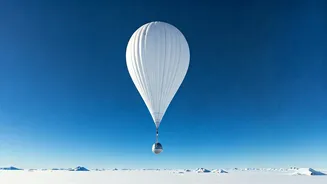
The Antarctic balloon campaign undertaken by NASA provided a remarkably cost-effective approach to scientific research, a major factor in its implementation.
This method allowed for the deployment of scientific instruments and payloads at high altitudes without the significant expenses tied to satellite launches or traditional rocket missions. The utilization of high-altitude balloons greatly reduced operational costs, enabling researchers to conduct extensive studies of the universe and Earth's atmosphere. Furthermore, the capacity to modify and retrieve instruments after each flight offered a level of adaptability that is often absent in more expensive space-based projects. This approach ensures valuable data collection, making the most of available resources to further scientific understanding.
The Payload Deployment
The campaign involved deploying a variety of instruments. These instruments were carefully selected and prepared to measure different aspects of the environment, including cosmic radiation, atmospheric conditions, and the behavior of celestial objects. The payloads were equipped with sophisticated sensors and data-gathering systems. These tools were designed to withstand the harsh conditions of the Antarctic environment. Support balloons were an integral component. These were crucial in maintaining the trajectory and stability of the main payloads. The collaboration between the primary instruments and the supporting balloon systems enabled extended data collection periods. This setup provided crucial insights for the scientists involved, facilitating significant advancements in the understanding of the universe.
Advantages of Antarctic Conditions
The Antarctic environment offers unique advantages that greatly enhance the effectiveness of balloon-based research. The extremely cold temperatures, stable atmospheric conditions, and the presence of the polar vortex contribute to extended flight durations and consistent data acquisition. The nearly constant daylight during the Antarctic summer is another significant benefit. These conditions allow for continuous observation periods. The relative isolation of Antarctica also reduces the interference from human-made radio signals and other sources of noise. This enhances the precision of the measurements. Furthermore, the absence of strong jet streams and turbulence ensures the payloads remain on course. This makes the Antarctic a premier location for long-duration balloon missions, supporting the attainment of detailed scientific data.
Mission Objectives and Instruments
The primary objectives of NASA's Antarctic balloon campaign centered around deepening the knowledge of space and earth’s atmosphere. The instruments onboard these balloons were designed to gather data on a wide variety of cosmic and atmospheric phenomena. These instruments included telescopes, spectrometers, and detectors. The data collected contributed to several scientific fields, including cosmology, astrophysics, and climate science. The findings from these missions provided crucial details regarding cosmic rays, the composition of the atmosphere, and the behavior of celestial bodies. The data also helped test new technologies, offering a detailed approach to research, which in turn, helped to provide valuable insights for scientific breakthroughs.