







Advanced Underwater Vehicle Selection
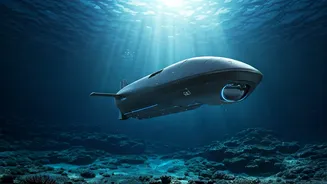
In a significant move for naval technology, an advanced autonomous underwater vehicle, known as Dive-XL, has been chosen to join the US Navy's new Combat
Autonomous Maritime Platform Project (CAMP). This selection was made through a rigorous competitive process managed by the Defense Innovation Unit. The Dive-XL is particularly well-suited for scenarios where traditional navigation systems like GPS are unavailable, such as deep-sea deployments and extended underwater voyages, marking a substantial leap in autonomous maritime capabilities for the Navy.
Dive-XL's Impressive Features
This remarkable vehicle boasts an entirely electric propulsion system, enabling it to cover distances exceeding 2,000 nautical miles and remain submerged for prolonged periods. Its design allows for the integration of up to three distinct payload modules, which can be utilized for surveillance operations, or even offensive missions. Furthermore, the Dive-XL can serve as a central hub for launching and managing smaller unmanned underwater vehicles. To date, Anduril's fleet of autonomous undersea vehicles has collectively logged over 42,355 kilometers and accumulated 6,752 hours of operational time, demonstrating a proven track record of performance and reliability in diverse underwater environments.
Modular Design & Deployment
A key advantage of the Dive-XL is its innovative modular hull construction. This feature allows the entire vehicle to be conveniently packed into standard shipping containers, facilitating easy transportation via trucks or aircraft. The design, which draws inspiration from Australia's Ghost Shark project, is manufactured in both Sydney and Rhode Island, with the production capacity to generate dozens of units annually. This scalability ensures that the Navy can rapidly equip its forces with this cutting-edge technology as needed, supporting widespread deployment and operational readiness.
Field Testing and Future Impact
Following its contract award, the Dive-XL is scheduled for an extensive field testing phase within a four-month timeframe. Several units are already actively engaged in operations across the United States, signifying the immediate application of this technology. This development represents a significant advancement in how the Navy approaches underwater domain awareness, surveillance, and security, promising enhanced operational effectiveness and expanded capabilities beneath the ocean's surface.