








A New Galactic Core?
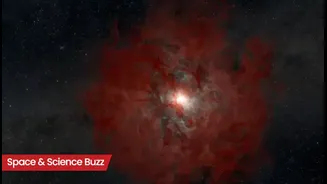
For decades, the scientific community has largely accepted that the central region of our Milky Way galaxy harbors a supermassive black hole, identified
as Sagittarius A* (Sgr A*). However, a recent scientific investigation has introduced a provocative alternative hypothesis. This new study posits that the dense nucleus of our galaxy could, in fact, be composed of a concentrated mass of fermionic dark matter, enveloped by a surrounding halo. This fascinating proposition aims to reconcile several peculiar astronomical observations that have puzzled scientists for years, suggesting that our preconceived notions about the galaxy's central structure may require a significant re-evaluation.
Dark Matter's Dance
This intriguing dark matter core theory offers compelling explanations for a variety of observed cosmic behaviors near our galactic center. For instance, it provides a plausible mechanism to account for the incredibly high speeds at which certain stars orbit Sgr A*, with some reaching astonishing velocities of up to 10% of the speed of light. Furthermore, the theory aligns with the presence of enigmatic, dust-obscured objects detected in close proximity. It also elegantly explains the complex rotation patterns of the galaxy, as mapped by the meticulous observations from ESA's Gaia spacecraft. Crucially, this model is also consistent with the iconic image captured by the Event Horizon Telescope, which depicts a luminous ring structure at the galaxy's core. Lead author Valentina Crespi highlighted that this unified model not only elucidates stellar orbits and galactic rotation but also harmonizes with the famous 'black hole shadow' image, presenting a cohesive, albeit unconventional, picture.
Future Observations Await
The scientific community is abuzz with anticipation as future observational efforts are planned to rigorously test these competing hypotheses. Astronomers intend to utilize the advanced GRAVITY instrument, situated on the Very Large Telescope, for a critical search. Their target will be the detection of photon rings, a distinct signature strongly associated with the presence of black holes. Should these specific rings be observed, it would lend substantial support to the long-held black hole model of Sgr A*. Conversely, if these photon rings remain elusive, it would significantly bolster the credibility of the recently proposed dark matter clump theory. The resolution of this profound mystery at the heart of our galaxy remains an open and exciting frontier in astronomical research.