




Europa's Icy Surface
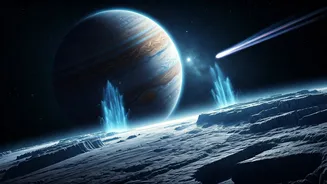
Europa, one of Jupiter's many moons, captivates scientists due to its potential for harboring life. Unlike Earth, Europa’s surface is primarily composed
of ice. This isn’t your average ice; it's a dynamic layer that scientists believe is constantly changing. This outer shell is relatively smooth compared to many other celestial bodies. Beneath this icy exterior lies a vast ocean, and it's the interaction between the surface ice and this subsurface ocean that has piqued scientific curiosity. This interaction, particularly the sinking ice, is now believed to be a key element in the story of potential life on Europa. This process is not just a fascinating geological feature; it might be the key to supporting any life forms that could exist in Europa's ocean. It's a fundamental process, shaping the environment and influencing the potential for life to flourish, or at least, have a chance to.
Sinking Ice's Role
The phenomenon of sinking ice on Europa is significant because it provides a method for transporting essential materials from the surface to the subsurface ocean. The ice on Europa isn't static; it undergoes a process where dense ice sinks through the less dense surrounding ice. This sinking ice is essentially a conveyor belt, carrying crucial resources down into the ocean below. These resources might include nutrients, minerals, and even organic compounds. In essence, sinking ice acts as a conduit, potentially delivering energy and the building blocks of life to the ocean, making it a potentially habitable environment. This process also allows the ice to provide new inputs into the ocean, allowing for a cycle of exchange. This cyclical flow could lead to life developing in a similar way to how it did on Earth.
Nutrient Delivery System
The sinking ice on Europa can be visualized as a sophisticated nutrient delivery system. Consider the ice as a way to send nutrients from the surface ice to the ocean below. On Earth, similar processes, such as upwelling in the oceans, are vital for distributing nutrients. In Europa's case, the sinking ice provides a pathway for surface materials to reach the subsurface ocean. This subsurface ocean, therefore, might be replenished with essential compounds. The sinking of the ice can include bringing in nutrients as well as organic material that may not be available otherwise, which is a key process for biological reactions to occur. This nutrient exchange is necessary to promote the conditions needed for the emergence and evolution of life. Without this input from the ice, the subsurface ocean may be barren, and without nutrients, no life could ever be sustained.
Energy Source Transport
Beyond just delivering nutrients, sinking ice may also be involved in transporting an energy source. The surface ice, exposed to Jupiter's radiation environment, might contain forms of energy. As this ice sinks, it could be carrying these sources down into the ocean. This energy could be in the form of certain chemical compounds, or even through heat transfer. The energy carried by sinking ice could also drive chemical reactions in the subsurface ocean. It's important to understand the transport of potential energy sources that could power any life that may reside within the subsurface ocean. If there are sources of energy in the ice, this could be a substantial factor for the possibility of life on Europa. This would then become another necessary element for life to exist within Europa.
Implications for Life
The process of sinking ice has significant implications for the potential existence of life on Europa. If sinking ice actively transports nutrients and energy, the subsurface ocean may be more conducive to life. In Europa’s scenario, it could mean that the ocean is more complex than scientists previously thought. With nutrient and energy delivery, any potential life on Europa might find an environment with increased possibilities for growth, metabolism, and reproduction. The sinking ice process isn't just a geological curiosity, it's a vital element in understanding the potential habitability of Europa. Future missions to Europa will focus on understanding the sinking ice to look for the building blocks of life. Without sinking ice, life would be almost impossible to exist.
Future Research Efforts
Scientists will undertake extensive efforts to study the nature of Europa's icy shell and its impact on the subsurface ocean. They're developing sophisticated models and utilizing data from missions like the Europa Clipper. These missions are designed to provide a better understanding of the processes occurring on Europa. Studying Europa's surface features will help researchers to better understand how the ice interacts with the subsurface ocean. Probing the ice itself, with instruments designed to detect organic molecules and other markers of life, is another vital element of research. The future for Europa research looks promising. The search for life in our solar system goes beyond Earth, and Europa might contain the biggest clue for that search.