







Planetary Alignment Begins
Get ready for an incredible sight in the heavens, visible to stargazers across India! Between April 16th and April 23rd, an unusual celestial gathering
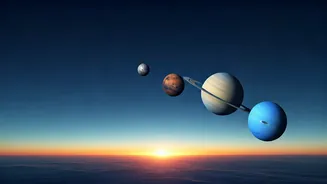
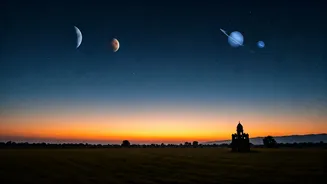
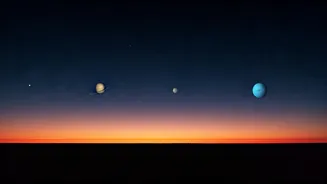
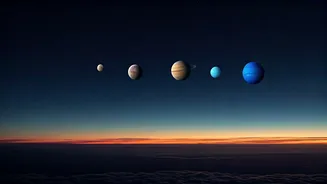
will take place, featuring four distinct planets gracing the predawn sky. This planetary parade includes the swift messenger Mercury, the fiery red Mars, the majestic Saturn, and the distant ice giant Neptune. To catch this phenomenon, you'll need to rise early and direct your gaze towards the eastern horizon approximately 30 minutes before the sun makes its appearance. This celestial alignment offers a fantastic opportunity for both seasoned astronomers and casual observers to witness the dance of our solar system's members from a unique perspective.
Peak Viewing Window
While the planetary alignment stretches across several days, the most spectacular views are anticipated to occur between April 18th and April 20th. During this peak period, the planets will be positioned in such a way that their visibility is optimized. Mars will be particularly noticeable due to its characteristic reddish hue, making it a standout feature in the morning sky. Neptune, being the most distant and faintest of the group, will require a bit more effort to spot; binoculars or a small telescope are highly recommended to discern its presence. For the best chance of observing all four planets clearly, it is crucial to find a location that is far removed from the disruptive glare of city lights and unobstructed by tall buildings or other man-made structures.
Spotting Mercury Easily
As the alignment progresses towards its conclusion, specifically by April 20th, spotting Mercury will become significantly easier. This inner planet, known for its proximity to the sun and thus challenging visibility, will be closer to the horizon, making it more accessible to observers. This improved visibility of Mercury adds another layer of excitement to the already impressive lineup. Therefore, if your goal is to witness all four celestial bodies – Mercury, Mars, Saturn, and Neptune – during this limited window, setting your alarms and being prepared to observe on or around April 20th is highly advisable. The effort to wake up early will be rewarded with a memorable astronomical spectacle.