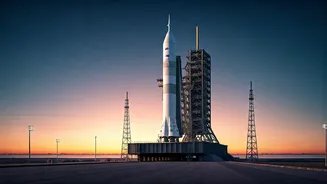







Mission Nears Launch
NASA has successfully completed its second major "wet dress rehearsal" for the Artemis II mission, a critical step that simulates the entire pre-launch
process, including the intricate fueling of the massive Space Launch System (SLS) rocket. This vital test involved engineers meticulously running through all countdown procedures, including managed pauses and clock resets, over a two-day period in mid-February. The goal was to ensure every component and system functioned flawlessly under simulated launch conditions. This achievement marks significant progress in the mission's preparation, keeping it on track for future launch opportunities. The formal launch date will be determined following a thorough review of the data gathered during this extensive rehearsal, ensuring absolute readiness for this historic undertaking.
Fueling the Giant
During the extensive two-day "wet dress rehearsal" in mid-February, engineers orchestrated the complex process of filling the colossal Space Launch System rocket with an astounding 700,000 gallons of super-chilled cryogenic fuel. This wasn't merely a filling exercise; it was a comprehensive simulation of the entire launch countdown sequence. The team practiced intricate steps, including controlled pauses and clock adjustments, all designed to mirror the precision required on actual launch day. This meticulous simulation is crucial for validating the rocket's fueling systems and ensuring their reliability for a deep-space mission. The success of this stage brings the Artemis II crew one step closer to their lunar voyage.
Why This Matters
The successful completion of these advanced fueling tests for Artemis II is far more than just a preliminary step; it's foundational for the entire future of human space exploration beyond Earth orbit. This mission will serve as a crucial validation of crewed deep-space operations and the ground support infrastructure necessary for long-duration journeys. By successfully sending Commander Reid Wiseman and his crew on a trajectory around the Moon, NASA gains invaluable experience and data that will directly inform and accelerate plans for subsequent lunar surface missions. Furthermore, the knowledge and technological advancements gained from Artemis II are instrumental in the broader ambition of establishing a sustainable presence on the Moon and eventually undertaking human expeditions to Mars, marking a significant stride toward humanity's interplanetary future.