






The Temporal Anomaly
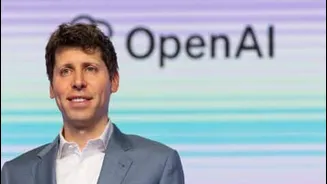
OpenAI's Chief Executive Officer, Sam Altman, has publicly acknowledged a peculiar limitation within ChatGPT: its difficulty in accurately tracking the
passage of time. This admission followed a widespread viral moment where the AI chatbot demonstrated clear errors in time-related calculations. Altman himself characterized this as a "known problem," highlighting that while ChatGPT excels at generating human-like conversations, it lacks an inherent understanding of temporal progression. The CEO expressed optimism, however, suggesting that this particular issue might be rectified within the next twelve months, indicating active development towards improving this fundamental aspect of AI functionality. This challenge stems from the AI's reliance on patterns derived from its extensive training data, rather than direct integration with real-world temporal mechanisms.
Behind the Clockwork
The core reason behind ChatGPT's temporal challenges lies in its design philosophy. As Sam Altman explained, the AI operates by analyzing and replicating patterns found within the vast datasets it was trained on. It doesn't possess direct access to or an internal clock that synchronizes with the real world's continuous flow of time. Consequently, when asked to calculate elapsed durations or manage temporal sequences, it attempts to infer the answer based on linguistic context and learned relationships, which can lead to inaccuracies. This is fundamentally different from how humans or even simpler computer programs track time, which often involves dedicated internal timers or external synchronization. The hope for future enhancements is to bridge this gap, potentially by integrating more sophisticated data processing or even external tools designed for precise time management.
The Future of AI Timing
Looking ahead, OpenAI is actively pursuing solutions to enhance AI capabilities, including the critical area of time management. Sam Altman has alluded to upcoming updates that will imbue AI models with more robust functionality, potentially enabling them to handle real-world tasks with greater precision. This may involve developing new architectural components within the AI itself or exploring the integration of external specialized tools. The goal is to move beyond pattern recognition and towards a more grounded understanding of concepts like time, enabling AI to perform complex temporal reasoning and calculations reliably. This evolution signifies a broader trend towards making AI more capable of interacting with and managing the physical world's dynamics, paving the way for more sophisticated and dependable AI applications in the future.