



Voyager's Lifeline
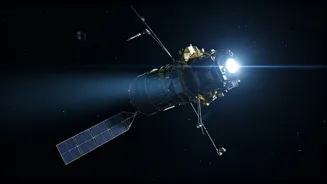
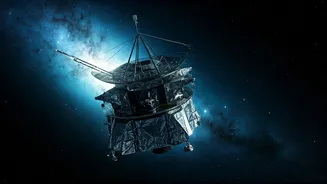
The legendary Voyager 1, launched in 1977 and now a staggering 15 billion miles from Earth, is still a beacon of scientific discovery, sending back vital
information from the far reaches of interstellar space. However, to ensure this iconic mission continues, NASA has made the difficult decision to temporarily switch off one of its science instruments: the Low-Energy Charged Particles Experiment, or LECP. This action is a critical step in NASA's ongoing efforts to manage the spacecraft's limited power reserves, demonstrating a commitment to extending its operational lifespan for as long as possible.
Plutonium Power Predicament
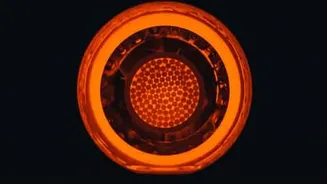
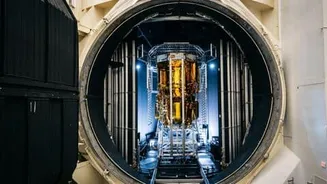
The longevity of Voyager 1 relies on its Radioisotope Thermoelectric Generators (RTGs), which convert heat from the decay of plutonium into electrical power. As this plutonium naturally decays over time, the power output of the RTGs diminishes annually. To prevent the spacecraft from experiencing automatic system shutdowns triggered by critically low power levels, NASA has proactively begun deactivating non-essential systems. The LECP is the most recent instrument to be powered down. Encouragingly, two other crucial instruments, one for studying plasma waves and another for analyzing magnetic fields, remain operational and continue to contribute to our understanding of the cosmos.
Extending the Exploration
With the power situation on Voyager 1 becoming increasingly constrained, NASA engineers are actively exploring and testing innovative strategies to maximize the remaining energy. These efforts are initially being focused on Voyager 2 as well, to refine techniques that could be applied to both probes. The primary goal is to stretch the operational capabilities of these venerable spacecraft, allowing them to continue their groundbreaking exploration of the universe for many more years to come, pushing the boundaries of human knowledge.