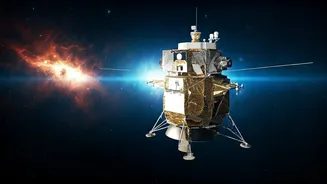







Voyager's Deep Space Mission
The groundbreaking Voyager 1 probe, launched in 1977, is currently traversing the immense void of interstellar space, a remarkable feat that places it
over 25.4 billion kilometers from Earth. This spacecraft, alongside its twin Voyager 2, was initially equipped with ten sophisticated scientific instruments designed to study the outer planets like Jupiter, Saturn, Uranus, and Neptune. Now, as they venture beyond the Sun's magnetic influence, known as the heliosphere, a critical challenge emerges: managing their dwindling power supply. These probes rely on radioisotope thermoelectric generators (RTGs), which convert heat from decaying plutonium into electricity. Over nearly five decades, these generators have experienced a consistent power loss of approximately four watts annually. This gradual reduction in energy has necessitated a careful strategy of deactivating instruments to prolong the operational life of the Voyagers well beyond their initial five-year design expectancy, allowing them to continue their unprecedented exploration of the unknown.
Power Saving Measures
In a bid to extend the operational lifespan of the Voyager 1 probe, NASA has made the strategic decision to deactivate another of its scientific instruments. The Low-energy Charged Particles experiment (LECP), responsible for studying the intricacies of interstellar space, has been powered down. This measure is crucial as the spacecraft journeys through uncharted interstellar territories where power is a precious commodity. Notably, a similar decision was made for the Voyager 2 probe in March 2025, indicating a consistent approach to managing these aging explorers. The probes are powered by radioisotope thermoelectric generators (RTGs), a reliable source of energy that has served them for nearly fifty years. However, these generators are subject to a gradual power decline, estimated at four watts per year. This consistent power drain compels mission engineers to make tough choices, prioritizing essential functions and carefully selecting which instruments can be switched off to conserve energy, thereby ensuring the continued transmission of valuable data from the farthest reaches of our solar system and beyond.
LECP's Scientific Role
The deactivation of the Low-energy Charged Particles experiment (LECP) on Voyager 1 marks the silencing of a vital instrument that has been instrumental in understanding the environment beyond our solar system for nearly 49 years. This experiment has meticulously recorded data on charged particles, including ions, electrons, and cosmic rays originating from both our solar system and the wider Milky Way galaxy. Its extensive observations have provided scientists with invaluable and unprecedented insights into regions characterized by varying densities outside the heliosphere. The LECP was equipped with sophisticated subsystems, including a specialized telescope and a magnetospheric particle analyzer. These components were mounted on a rotating platform, powered by a stepper motor, which allowed for a comprehensive 360-degree view of its surroundings. This design enabled it to capture a broad spectrum of data, contributing significantly to our comprehension of the heliosphere's outer boundaries and the interstellar medium.
Navigating Interstellar Challenges
As Voyager 1 continues its extraordinary journey into interstellar space, mission control faces constant challenges in maintaining its functionality. The probe's power systems, reliant on radioisotope thermoelectric generators, are progressively weakening, losing an estimated four watts of power annually since their launch nearly five decades ago. This gradual energy depletion necessitates careful management, leading to the deactivation of instruments like the LECP. A recent event highlighted these challenges: during a routine roll maneuver on February 27, intended to calibrate the magnetometer, mission engineers observed an unexpected dip in Voyager 1's power levels. Such power drops are critical because they risk triggering an automatic failsafe system, known as the undervoltage fault protection system, which could inadvertently shut down essential operations. The constant need to balance instrument operation with power conservation underscores the ingenuity required to keep these pioneering spacecraft operational in the harsh, distant environment of interstellar space.