


The 'AI-Free' Movement
In an era where artificial intelligence is rapidly transforming various sectors, a significant wave of initiatives is underway to establish a universally
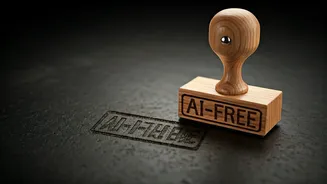
recognized mark for products and services created entirely by human hands. This burgeoning trend is a direct reaction to escalating anxieties surrounding job displacement caused by AI-powered automation. Consequently, declarations such as 'Proudly Human,' 'Human-made,' 'No AI,' and 'AI-free' are beginning to appear across a spectrum of media, including visual content, marketing campaigns, literary works, and online platforms, signaling a growing desire for human authenticity in an increasingly automated marketplace.
Quest for Universal Standards
A considerable effort is being channeled into creating a unified certification system, aiming for the same global resonance as the well-established 'Fair Trade' logo, which signifies ethical production. Currently, no fewer than eight distinct initiatives are actively engaged in this pursuit. However, the proliferation of competing labels and the inherent ambiguity surrounding what precisely constitutes 'AI-free' are raising concerns among experts. They caution that this fragmentation could lead to widespread consumer confusion unless a singular, agreed-upon standard is adopted to build trust and confidence in the marketplace, as highlighted by consumer expert Dr. Amna Khan.
Generative AI's Broad Impact
The impetus behind developing AI-free certification systems stems from the increasing capability of generative AI tools to replicate and, in some cases, surpass human work and creativity across a multitude of industries. Sectors like fashion design, advertising, publishing, customer service, and music production are all experiencing this shift. Organizations located in the United Kingdom, Australia, and the United States are actively involved in pioneering these new labels. Nevertheless, industry professionals anticipate significant hurdles in achieving consensus on the precise definition of 'human-made,' given the pervasive integration of AI into the very tools and platforms used daily across these fields.
Defining 'Human-Made' Now
The very concept of 'human-made' is being fundamentally challenged and complicated by generative AI technologies, which can produce text, code, music, or video content based on human-provided prompts. In response to this evolving landscape, several organizations are proactively implementing disclaimers to clearly communicate that no generative AI was employed in the creation of their offerings. However, the overarching challenge persists: establishing a globally accepted benchmark for what truly qualifies as 'AI-free' content remains an intricate and ongoing endeavor.
Arts Industry Under AI
The creative arts sector has found itself particularly susceptible to the growing prevalence of AI-generated content. Entire books and feature films are now being brought to life using AI technology, often at a pace and cost that significantly undercut traditional production methods. To address this, some businesses are beginning to adopt specific markings on their products, such as 'Human Written' or 'No AI was used,' serving as a transparent indicator to consumers that the content was not produced through artificial intelligence, thereby reaffirming human authorship and creative input.