






A New Era Dawns
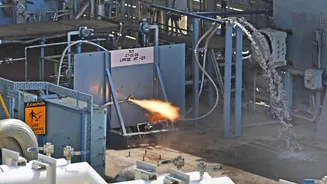
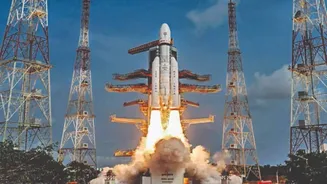
On January 27, 2026, the Indian Space Research Organisation (ISRO) achieved a pivotal moment in its quest for advanced rocket propulsion. At the ISRO Propulsion
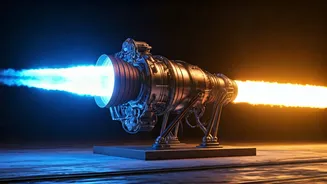
Complex (IPRC) in Mahendragiri, a groundbreaking hot test was conducted for their first high-thrust Liquefied Oxygen (LOX) and Methane engine. This significant event took place at the Thrust Chamber Test facility, showcasing the successful ignition and sustained operation of a sub-scale thrust chamber coupled with a single-element injector head. The components themselves were marvels of modern engineering, realized through the intricate processes of additive manufacturing, often referred to as 3D printing in a broader sense. During the test, the engine achieved a remarkable chamber pressure of 56 bar, a truly impressive feat for a preliminary trial. This successful demonstration signifies a monumental leap forward in ISRO's development of next-generation rocket engines, setting the stage for enhanced capabilities in future space missions and highlighting India's growing prowess in space technology.
Fueling the Future
The adoption of a LOX-Methane fuel combination offers a compelling array of advantages that are set to redefine rocket propulsion. Methane, when paired with liquid oxygen, not only delivers substantial power but also presents a more economical and environmentally conscious alternative to traditional propellants. Its production process is comparatively less complex and less expensive, contributing to reduced mission costs. Furthermore, methane boasts superior storage characteristics, allowing for easier handling and longer shelf life compared to some other cryogenic fuels. Its inherently low toxicity profile also enhances safety for ground crews and mission personnel, minimizing risks associated with fuel handling. This combination of efficiency, cost-effectiveness, and reduced environmental impact makes LOX-Methane an increasingly attractive option for the future of space exploration, aligning with global efforts towards more sustainable practices in aerospace.
Innovations in Design
The success of ISRO's recent hot test is intrinsically linked to the advanced manufacturing techniques employed in creating the engine's critical components. The sub-scale thrust chamber and the single-element injector head were both fabricated using additive manufacturing processes. This method allows for the creation of highly complex geometries and integrated systems that would be challenging or impossible to achieve with conventional manufacturing. By using additive manufacturing, ISRO could precisely engineer the injector's performance and the chamber's thermal management, crucial factors for achieving high chamber pressures and stable combustion. The ability to rapidly iterate and produce intricate designs directly contributes to shortening development cycles and optimizing engine performance. This technological approach not only validated the functionality of these 3D-printed parts under extreme conditions but also underscores the potential of advanced manufacturing to drive innovation and efficiency in the development of future spacecraft propulsion systems.