





Funding the Future
A significant milestone has been achieved in the burgeoning field of reusable space technology. Lux Aeterna, a startup founded in late 2024 by a former
SpaceX executive, has successfully secured $10 million in seed funding. This substantial investment was spearheaded by Konvoy and supported by a consortium of other keen investors, marking a strong vote of confidence in the company's ambitious vision. This latest funding injection follows an initial pre-seed round that garnered $4 million, bringing the total capital raised to an impressive $14 million. This financial backing is crucial for accelerating the development and deployment of their groundbreaking satellite technology, signaling a pivotal moment for the company and the broader space industry.
Reusable Satellite Design
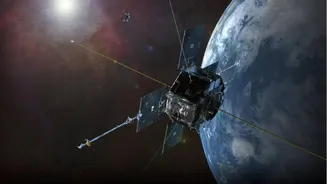
At the heart of Lux Aeterna's innovation lies the concept of a fully reusable satellite bus designed specifically for low Earth orbit. Unlike traditional satellites that are discarded after their mission, these new spacecraft are engineered for recovery and refurbishment. They employ advanced heat shield technology, drawing inspiration from NASA's proven designs, to withstand the harsh conditions of atmospheric re-entry. This allows the satellites to survive their return to Earth, where they can then be meticulously serviced and prepared for subsequent missions. The vision is akin to a 'space Uber,' offering a sustainable and cost-effective platform for a diverse range of applications, including scientific experiments, defense technology demonstrations, hypersonic testing, and even in-orbit manufacturing processes. The company's operations are currently based out of a 6,000-square-foot facility in Denver.
The Delphi Satellite Program
The innovative 'Delphi' satellites are the flagship product of Lux Aeterna's reusable technology initiative. A key design feature of these satellites is the ability to recover the scientific or technological payloads without the need to retrieve the entire satellite structure each time. This modular approach enhances the efficiency and flexibility of space missions. The company has set a target for the first Delphi return mission in 2027, with plans to conduct this at Australia's Koonibba Test Range. A second Delphi mission is also in the pipeline, though its exact timeline has not yet been specified. While the specific launch vehicles and detailed schedules for these planned returns are still being finalized, the successful implementation of this program promises to dramatically increase the efficiency of satellite operations and significantly reduce the amount of space debris generated, paving the way for a more sustainable approach to space exploration.