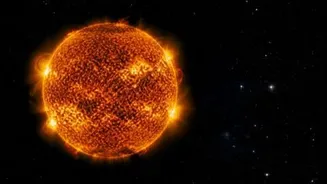








The Solar Enigma
For ages, astronomers have grappled with a perplexing solar phenomenon: why do some regions of our Sun attain dramatically higher temperatures than others?
This uneven heating has long been a scientific riddle, defying simple explanations based on our understanding of solar physics. Recent investigations, spearheaded by researchers at Tezpur University, propose a compelling new answer, focusing on the role of specific, energetic particles. Their groundbreaking work suggests that certain elusive entities within the sun's plasma are not just passive participants but actively influence the distribution and intensity of solar heat. This revelation promises to reshape our comprehension of our star's dynamic interior and its outward radiation, offering a fresh perspective on the very processes that fuel our solar system and impact life on Earth. The implications extend beyond pure scientific curiosity, potentially paving the way for advancements in solar energy utilization and space weather prediction.
Electrons' Energetic Influence
The key to unlocking this solar puzzle lies with what scientists call "nonthermal electrons." These are not your average, everyday electrons; they possess significantly higher energies. The Tezpur University team discovered that an abundance of these high-energy nonthermal electrons has a profound effect on the sun's internal dynamics. Specifically, they found that these particles act to dampen the normal pressure waves, known as p-modes, which are fundamental to the transport of energy within the sun's plasma. Instead of propagating as usual, the energy associated with these waves is redirected, predominantly moving upwards towards the Sun's outer atmosphere. This redistribution is hypothesized to be a significant contributor to the heating of the chromosphere and corona, the Sun's less understood, outermost layers, which are observed to be far hotter than the surface.
Modeling the Sun's Heat
To solidify their intriguing theory, the researchers at Tezpur University embarked on the creation of a sophisticated computational model. This model was meticulously designed to simulate how acoustic energy within the solar atmosphere would gradually dissipate, taking into account both atmospheric and magnetic influences. The critical validation of their work came when the predictions generated by their model closely aligned with real-world observational data. These data were sourced from powerful instruments aboard space telescopes operated by NASA and Japan, renowned for their precision in capturing solar activity. This remarkable agreement between their theoretical framework and empirical evidence provides robust support for the role of nonthermal electrons in explaining the solar heating mystery, bringing us substantially closer to a comprehensive understanding of our star's intricate workings.