





Sky Brightening Concerns
The prospect of deploying numerous reflective satellites and mirrors into Earth's orbit is a growing concern for the scientific community. Researchers
warn that these celestial installations could profoundly alter the planet's natural light conditions, leading to widespread disruptions across ecosystems. This potential environmental upheaval has prompted presidents of major international scientific societies, representing a vast network of researchers from over 30 nations, to formally express their apprehension to regulatory bodies like the US Federal Communications Commission (FCC). The sheer scale of these proposed orbital deployments suggests a significant and potentially irreversible alteration to the natural night-time environment that has sustained life for millennia. This could have far-reaching consequences for everything from human health to the intricate balance of natural habitats worldwide.
Biological Clock Chaos
The introduction of vast reflective surfaces into low Earth orbit poses a direct threat to the fundamental biological rhythms of life on our planet. These orbital mirrors, designed to redirect sunlight, could dramatically increase the ambient light during natural night hours across the globe. This pervasive artificial illumination has the potential to scramble the intricate biological clocks that govern essential processes in both humans and animals, including sleep patterns and hormone production. Nocturnal species, which rely on darkness for navigation and foraging, could find their migration routes disrupted. Furthermore, the delicate seasonal cycles of plants, which depend on predictable periods of light and darkness, might be thrown into disarray. Even the microscopic phytoplankton in our oceans, crucial to marine food webs, could have their rhythms disturbed, potentially impacting the entire aquatic ecosystem from the bottom up.
Threat to Food Security
Beyond the disruption of natural rhythms, the proposed orbital lighting solutions carry significant implications for global food security. Scientists are urging regulatory bodies to conduct comprehensive environmental assessments and to implement strict limitations on the reflectivity of satellites and the cumulative brightness they contribute to the night sky. Experts highlight that plants, fundamental to our food systems, have evolved to require periods of darkness for crucial physiological processes. The proposed technology, with plans for satellites featuring large reflective mirrors to beam sunlight onto specific areas on demand, could disrupt these essential dark cycles. This interference with plant life could have cascading effects on agriculture and food production, raising serious questions about our ability to feed a growing global population if these artificial light sources become widespread.
Mega Constellations
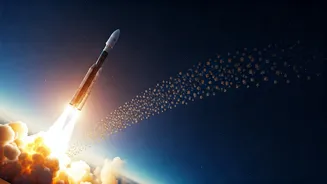
Adding to these concerns is the ambitious plan by SpaceX to launch up to one million satellites, forming a colossal solar-powered computing network in orbit. While the company suggests this system could reduce the energy demands of terrestrial data centers, the sheer volume of satellites raises significant environmental questions. Critics and experts alike are voicing apprehension about the cumulative impact of such a vast constellation on both the night sky and the delicate balance of Earth's ecosystems. This proposal exacerbates existing worries about light pollution, as even the current number of satellites orbiting our planet has already led to a measurable increase in diffuse night sky brightness. This escalating sky glow, a phenomenon observed by organizations dedicated to preserving natural darkness, is a precursor to the more drastic changes anticipated with future large-scale deployments.
Existing Sky Glow
The concern is not purely theoretical; the existing satellite population is already contributing to a noticeable increase in night sky brightness. Experts have observed that individual satellites can leave streaks in sensitive astronomical images, while the collective reflection of sunlight from these objects and other orbital debris is subtly but measurably brightening the night sky. Studies using predictive modeling indicate that this diffused light pollution has already elevated the night sky's brightness by approximately 10%. The implications are significant, as even small increments in brightness can be detected by biological systems. The question is not merely how bright the sky becomes in comparison to natural moonlight, but whether these changes are substantial enough to trigger detectable responses in the intricate biological systems that have adapted to millennia of predictable celestial illumination.
Future Brightness Projections
Looking ahead, projections based on current trends and proposed satellite deployments paint a concerning picture for the future of our night skies. Modeling suggests that the existing contribution to night sky brightness from satellites and debris already falls within a range of 3 to 8 microcandela per square meter. By the year 2035, these figures are predicted to surge significantly, potentially reaching between 5 and 19 microcandela per square meter. This projected increase brings the cumulative brightness perilously close to the threshold that astronomers consider essential for preserving naturally dark skies, a vital resource for scientific observation and for the health of nocturnal ecosystems. The core issue for biologists is not just the overall brightness, but the capacity of living organisms to perceive and react to these subtle yet persistent alterations in their environment.