




Mission Launch and Trajectory
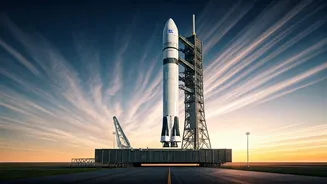
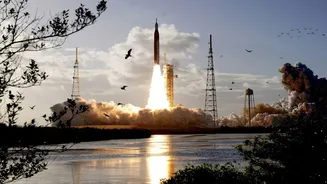
NASA's Artemis II mission has officially commenced its historic voyage, marking humanity's return to the vicinity of the Moon after a hiatus of more than
five decades. The powerful Space Launch System (SLS) rocket successfully propelled the Orion spacecraft into space on April 1st, local time. This mission's primary objective is not to land on the lunar surface, but rather to conduct a close flyby. The spacecraft is slated to reach its closest point to the Moon on day six of its journey, approximately April 6th. This carefully planned trajectory ensures that the crew experiences the awe-inspiring proximity of our celestial neighbor, building on the legacy of past lunar expeditions while paving the way for new discoveries.
Record-Breaking Distance
The Artemis II mission is set to etch its name in the annals of space exploration by venturing farther from Earth than any previous crewed mission. The Orion spacecraft will journey approximately 400,000 kilometers away from our home planet. This impressive feat surpasses the record previously held by the Apollo 13 mission. Following its close encounter with the Moon, the spacecraft will utilize a clever 'free-return trajectory.' This ingenious orbital path leverages the Moon's gravitational pull to naturally guide Orion back towards Earth, offering an inherent safety net by ensuring a safe return even in the unlikely event of propulsion system malfunctions. This strategic use of celestial mechanics highlights the sophisticated planning behind the Artemis program.
Lunar Observation Window
During its closest approach to the Moon, the Orion spacecraft will be positioned at a remarkable altitude of about 6,600 kilometers above the lunar surface. From this vantage point, the Moon will appear as a distinct, substantial object, akin to a basketball held at arm's length. The crew aboard Orion will have a concentrated period of just three hours to conduct their essential observations of the lunar landscape. NASA has equipped the astronauts with an extensive list of scientific objectives and survey tasks to accomplish within this limited timeframe. This intense observation period underscores the mission's focus on gathering critical data and visual information about the Moon's surface.
Return and Mission Significance
The journey back to Earth for the Artemis II crew is anticipated to span approximately four days. Upon reaching Earth's atmosphere, Orion is programmed for a high-speed reentry, culminating in a splashdown in the Pacific Ocean, scheduled for April 10th. This mission represents a monumental step forward, signifying the first time humans have journeyed this far from Earth since the Apollo era concluded in 1972. Although Artemis II is designated as a test flight, its success is paramount. It serves as the crucial groundwork for future Artemis missions, which aim to land astronauts back on the Moon and to further explore the vastness of deep space, pushing the frontiers of human exploration.