







The Fiery Ring
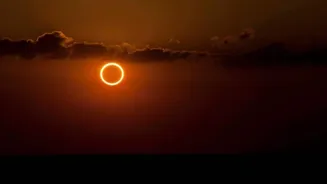
Get ready for an annular solar eclipse on February 17, 2026, often called a "ring of fire" eclipse. This occurs when the Moon journeys between our planet
and the Sun, but its alignment means it doesn't quite obscure the solar disc entirely. The visual result is a stunning, luminous halo of sunlight encircling the Moon's dark outline. While this particular celestial event's most dramatic views will be predominantly over Antarctica and the vast Southern Ocean, skygazers in the southern reaches of South America and parts of Southern Africa will still have the chance to witness a partial spectacle. Unfortunately for those in India and the broader Northern Hemisphere, this annular eclipse will not be visible from these locations.
Total Eclipse Grandeur
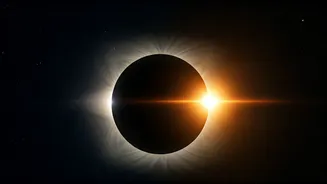
Following the annular display, 2026 will host another incredible cosmic show on August 12: a total solar eclipse. This phenomenon unfolds when the Moon achieves a perfect alignment, completely blotting out the Sun for observers situated within its narrow path. For those lucky enough to be in this zone, daylight will temporarily transform into an eerie twilight. The path of totality for this extraordinary event will sweep across intriguing locales like Greenland, Iceland, and extend into various regions of northern Spain. A partial phase of this total solar eclipse will also be observable across much of Europe, and significant portions of Canada and Portugal.
Safe Viewing Practices
Witnessing a solar eclipse demands strict safety precautions to protect your vision. Under no circumstances should you ever attempt to observe a solar eclipse with your unprotected eyes or by using standard sunglasses, as this can lead to permanent eye damage. The only way to view these events directly and safely is by using specialized ISO-certified solar viewers or professional-grade solar filters. For individuals situated outside the eclipse's visibility path, or those who prefer to watch from the comfort of their homes, numerous live streaming options are readily available. Reputable space agencies, astronomical observatories, and dedicated science websites consistently provide high-quality broadcasts of these celestial events. Beyond their visual magnificence, solar eclipses are invaluable opportunities for scientists to conduct crucial research into the Sun's outer atmosphere, known as the corona, and to study the dynamics of Earth's upper atmosphere.