





Gravity's Cosmic Boost
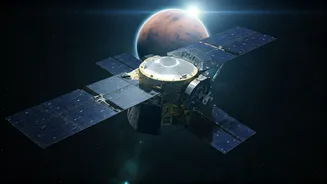
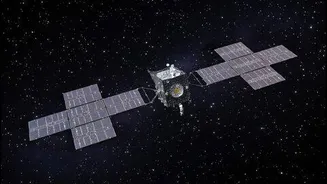
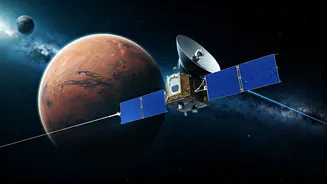
In a remarkable feat of orbital mechanics, NASA's Psyche spacecraft is scheduled to perform a gravity assist maneuver around Mars on May 15, 2026. This
strategic flyby will see the probe pass a mere 4,500 kilometers above the Martian surface, a distance closer than its own moons. This close encounter is not just for a scenic view; it's a calculated move to harness the Red Planet's gravitational pull. By carefully navigating this proximity, Psyche will gain significant velocity, accelerating to nearly 20,000 kilometers per hour. Crucially, this speed boost will be achieved without expending any additional onboard fuel, showcasing an efficient and ingenious approach to interplanetary travel and setting the stage for its long voyage.
Destination: Asteroid Psyche
Following its crucial encounter with Mars, the Psyche spacecraft will embark on its primary mission: a journey to asteroid 16 Psyche. This celestial body is of immense scientific interest, theorized to be a colossal piece of nickel and iron, possibly representing the exposed metallic core of an ancient protoplanet. The flyby of Mars serves a dual purpose, offering not only a propulsive advantage but also an opportunity for instrument calibration. NASA scientists will utilize this period to fine-tune a magnetometer designed to study the interaction between Mars's magnetic field and incoming solar particles, as well as a detector that tracks cosmic rays. Furthermore, the mission team aims to scan for any faint dusty rings, or tori, that might encircle Mars, potentially formed by debris ejected from its moons, Phobos and Deimos, due to micrometeorite impacts. This multi-faceted flyby is essential for conserving mission resources and preparing Psyche for an unprecedented close-up exploration of a truly unique world.