




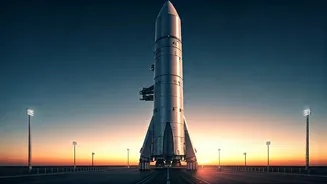
Long-Term Space Goals
SpaceX, a company renowned for its groundbreaking advancements in space exploration, has recently conveyed a more cautious outlook to its investors regarding
the profitability of its most ambitious long-term projects. These include the monumental task of establishing human settlements on both the Moon and Mars, as well as pioneering the development and deployment of sophisticated artificial intelligence systems within orbit. In its initial public offering (IPO) filing, the company frankly admitted that these ventures are still in their nascent, experimental phases. They are confronted by formidable environmental challenges, such as the pervasive cosmic radiation and the extreme temperature fluctuations characteristic of extraterrestrial environments. This disclosure marks a departure from the previously expressed optimism by its leader, Elon Musk, concerning the timeline for realizing financial returns from these daring space missions, suggesting a more measured approach to market expectations.
AI Integration Focus
Despite the acknowledged hurdles in interplanetary colonization, SpaceX remains steadfast in its commitment to advancing artificial intelligence capabilities. The company is actively exploring significant investments in the AI sector, reportedly considering a substantial $60 billion acquisition of the code-generation startup Cursor, or alternatively, a $10 billion partnership. These strategic moves are designed to significantly enhance SpaceX's proprietary AI technologies, leveraging the immense computational power of its Colossus supercomputer. These bold initiatives are integral to the company's broader strategy as it prepares for a potential IPO, an event that could skyrocket SpaceX's valuation to an astonishing $1.75 trillion. This ambitious valuation underscores the immense and rapidly growing global market for artificial intelligence solutions, highlighting AI as a central pillar of SpaceX's future growth and influence.