






The Moon's Influence
The Moon, a constant presence in our night sky, isn't just a pretty sight; it's a silent architect of Earth's atmosphere. Recent research has shed light
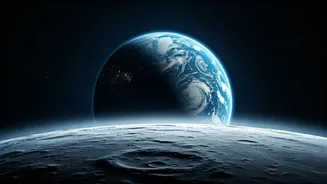
on how the Moon interacts with Earth's atmospheric particles, specifically those escaping our planet's grasp. This interaction, though subtle, has been occurring for billions of years, leaving a profound impact that scientists are just beginning to fully understand. This interplay involves the continuous bombardment of the Moon's surface by atmospheric particles, a subtle process but one that has drastically changed the composition of Earth's atmosphere across eons. This continuous exchange and the subsequent loss of atmospheric elements have fundamentally shaped our planet's ability to support life.
Apollo Discoveries
The Apollo missions served as pivotal moments in our quest to understand the Moon's impact on Earth. These missions facilitated the collection of invaluable data about the lunar environment. Astronauts brought back lunar samples and conducted experiments. These studies showed direct evidence of the Moon's interaction with the solar wind, a stream of charged particles constantly emanating from the Sun. Analysis of these samples revealed that the Moon's surface is constantly bombarded by solar wind particles, causing a subtle yet significant erosion effect. These findings were critical in establishing a baseline understanding of how our atmosphere escapes and the role the Moon plays in the entire process. Furthermore, the Apollo missions expanded our understanding of the Moon's composition, its formation, and its influence on Earth’s tides and climate.
Validation Process
To ascertain the claims of the Moon consuming our atmosphere, scientists have employed rigorous validation processes. These procedures involve data from multiple sources. Observations from the Apollo missions, for instance, became the bedrock of initial theories. Scientists have developed sophisticated models to predict and simulate how atmospheric particles interact with the lunar surface. These models account for factors such as solar wind, lunar gravity, and the Moon's magnetic field. This validation process also involves advanced analytical techniques. Scientists have analyzed data gathered by space-based instruments to monitor the Earth's atmosphere continuously. These observations contribute to a holistic view. They help refine existing models and validate the findings from lunar missions, thus providing stronger evidence.
A Direct Path
The path to understanding the Moon's atmospheric influence is a direct one. The interactions occur through various mechanisms, primarily by way of charged particles. These particles collide with the lunar surface. Because the Moon lacks a substantial atmosphere and a global magnetic field, it's vulnerable to the constant bombardment of solar wind. This exposure causes atmospheric particles to directly collide with the Moon's surface and the processes associated with these collisions. Scientists have identified how hydrogen and helium atoms from Earth's upper atmosphere are stripped away by the solar wind and become trapped on the lunar surface. Further research indicates how the Moon's gravity also contributes to the loss of atmospheric gases. Some gases that stray near the Moon are gravitationally pulled away from Earth, further depleting our atmosphere over vast timescales.
The New Theory
The initial understanding of the Moon's effect on Earth's atmosphere has continuously evolved, leading to refined hypotheses and theories. The latest theories propose the existence of intricate, complex interactions. These interactions, far from being solely a one-way process of atmospheric loss, are much more dynamic. The new theories suggest that the Moon might also be temporarily trapping particles from the Earth’s atmosphere. The solar wind particles, which hit the lunar surface, are re-emitted, and some re-enter the Earth's upper atmosphere during specific phases of the lunar cycle. The updated theories account for how the Moon subtly modulates the Earth's magnetosphere, which, in turn, influences the extent of atmospheric loss. These emerging theories are changing scientists' comprehension of the Moon-Earth relationship. This research promises a clearer picture of the interplay between these celestial bodies.