



Agile Exploration Advancements
The hunt for life beyond Earth is getting a significant boost thanks to sophisticated robots designed for challenging environments. Leading this charge
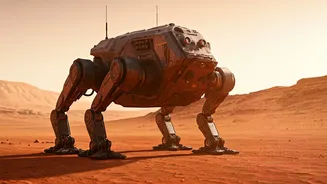
is a class of four-legged automatons, exemplified by ANYmal, which are proving to be far more adept at navigating Mars-like conditions than their wheeled predecessors. In simulated Martian test environments, these robotic explorers demonstrated a remarkable ability to traverse rugged, dusty landscapes, completing their assigned tasks up to three times faster than conventional exploration methods. This enhanced speed is crucial for missions where time and resource efficiency are paramount, allowing for more extensive surveying and a greater chance of discovering vital biosignatures within mission constraints.
Conquering Martian Terrain
ANYmal's innovative design, featuring articulated legs rather than wheels, grants it unparalleled mobility. This allows the robot to overcome obstacles that would easily halt wheeled vehicles, such as large rocks, steep inclines, and loose debris. Its ability to maintain a stable gait and grip on challenging surfaces means it can venture into previously inaccessible areas, including ancient riverbeds and crater floors—locations highly favored by astrobiologists for potentially harboring evidence of past or present microbial life. This enhanced reach is a game-changer, opening up vast unexplored regions of Mars for scientific investigation and increasing the probability of significant discoveries.
Smart Autonomy Boosts Efficiency
Beyond its physical capabilities, ANYmal boasts advanced autonomous navigation systems, significantly reducing its reliance on constant communication with Earth. This onboard intelligence allows the robot to make real-time decisions, adapt to unexpected environmental changes, and plot optimal paths without continuous human input. Such autonomy is vital for deep-space missions where communication delays can be substantial, hindering rapid response and efficient exploration. By minimizing downtime and maximizing operational effectiveness, these smart robots promise to make future Mars exploration endeavors considerably smoother and more productive, accelerating our understanding of the Red Planet's potential to harbor life.