





Cozy Cabin Design
NASA's Orion spacecraft, a pivotal component of the ambitious Artemis missions, is engineered to carry astronauts further into the cosmos than any capsule
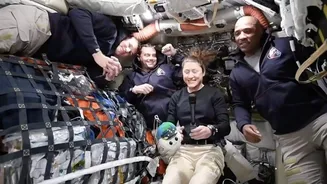
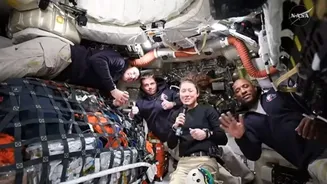
in recent memory. Yet, this technological marvel comes with a significant caveat: its interior living volume is remarkably constrained. The habitable area within Orion amounts to approximately 330 cubic feet, a space comparable to that of two standard minivans parked end-to-end. This compact environment must meticulously accommodate a crew of four astronauts, their essential equipment, and vital life-support systems for the entirety of their mission duration. The design prioritizes functionality and efficiency, eschewing any notion of separate cabins or private nooks. Instead, every element – from the astronauts' seats and the intricate control panels to crucial storage compartments and the complex life-support machinery – is ingeniously integrated into this single, shared expanse. During the intense phases of launch and re-entry, the astronauts are secured in their seats, with very limited mobility. It is only when they enter the weightless environment of microgravity that they can unstrap and navigate their small, albeit functional, domain.
Sleeping Quarters Reimagined
Forget about beds and spacious rooms; sleeping aboard the Orion spacecraft is an exercise in minimalist adaptation. Astronauts do not have traditional beds; instead, they utilize sleeping bags that are secured to the spacecraft's walls. This ingenious solution ensures they remain in place and don't drift freely in the zero-gravity environment. However, it also means that personal space is virtually non-existent, with the entire crew sharing the same confined area throughout their mission, night and day. Even the simplest of activities, such as preparing a meal or moving from one point to another within the capsule, requires careful planning and execution to prevent the limited space from becoming overwhelmingly cluttered or chaotic. Every action is deliberate, contributing to the overall harmony and functionality of the tightly packed living quarters. This approach underscores Orion's primary function as a vehicle for transit rather than a long-term dwelling.
Transport, Not Home
Despite its compact dimensions, the Orion spacecraft represents a significant leap forward in technology compared to earlier vehicles that ventured beyond low Earth orbit. It is equipped with enhanced life-support mechanisms, advanced navigation capabilities, and robust safety features designed for the rigors of deep space travel. Crucially, it's important to understand that Orion functions primarily as a transport vehicle; it is not intended for extended periods of habitation. While it serves admirably for its current mission profiles, future endeavors that involve longer stays on the lunar surface or the ambitious objective of journeys to Mars will necessitate the development of substantially larger and more specialized habitats. Orion's role is to efficiently and safely ferry astronauts to their destinations, setting the stage for subsequent, more complex exploration phases that will require different kinds of living solutions.