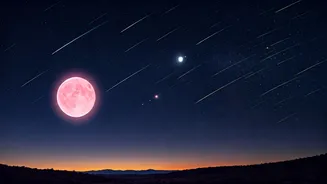







Lunar Glow & Planetary Dance
The celestial show in April 2026 commences with the visually striking Pink Moon gracing the night sky on April 1st, offering a beautiful, full-night spectacle.
Shortly after, on April 3rd, Mercury will reach its greatest western elongation, presenting an optimal opportunity for observation just before sunrise. The following day, April 4th, sees Comet C/2026 A1 (MAPS) making its closest approach to the Sun, a perihelion event that, while potentially challenging to view directly, promises increased brightness and a remarkable presence in the sky for those equipped to observe it. These early April events set a captivating tone for the astronomical wonders yet to unfold, highlighting the dynamic nature of our solar system and offering early chances to connect with the cosmos.
Rare Planetary Parade
The middle of April 2026 brings a truly captivating celestial gathering. Between April 16th and 23rd, a rare planetary parade is scheduled to occur during the pre-dawn hours, typically between 4:30 am and 5:30 am EDT. This phenomenon involves several planets appearing in a line across the sky, creating a stunning visual display. Adding to this already magnificent event, on April 18th and 19th, the Moon will join Venus and the Pleiades star cluster, forming a breathtaking alignment within the same pre-dawn viewing window. This convergence of planetary bodies and a familiar celestial asterism offers a unique chance to witness the grand architecture of our solar system in a visually coherent and memorable fashion.
Galactic Views & Shooting Stars
As April 2026 progresses, the wonders extend to deep space and celestial fireworks. From April 20th to April 30th, the magnificent Whirlpool Galaxy, also known as M51, will be accessible for observation during the late evening, typically between 10:00 pm and midnight EDT. This grand spiral galaxy, a testament to the vastness of the universe, offers a chance to glimpse cosmic structures far beyond our own galactic neighborhood. Following closely, the highly anticipated Lyrid meteor shower will reach its peak on April 22nd and 23rd. Between midnight and 4:00 am EDT on these nights, skywatchers can expect to see a dazzling display of shooting stars as Earth passes through the debris trail of the comet C/1861 G1 (Thatcher), providing a truly spectacular natural light show.
Aurora Magic & Viewing Tips
Concluding April 2026 with another ethereal spectacle, the Aurora Borealis, or Northern Lights, is predicted to be visible from April 25th to April 30th. These displays of dancing lights in the night sky can typically be seen between 10:00 pm and 2:00 am EDT. To maximize your chances of witnessing these incredible celestial events, it is highly recommended to seek out locations far from the light pollution of cities. For those planning to observe pre-dawn events, remember that temperatures can drop significantly; dressing in layers and bringing along a comfortable chair or blanket is advisable. Always prioritize safety when stargazing, especially in remote areas, by adhering to local guidelines and informing someone of your plans.