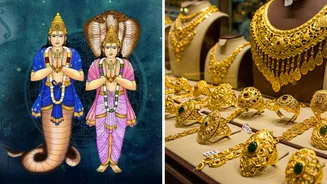

People often ask whether it’s a bad idea to wear gold on Rahu or Ketu days, usually after hearing a warning from someone older in the family or spotting
a random rule online. The confusion makes sense. Rahu and Ketu already carry a slightly uneasy reputation in astrology, so it’s easy to assume that anything linked to wealth or display, like gold, must automatically clash with them. But Vedic astrology doesn’t really work in such clean, black-and-white rules. To begin with, Rahu and Ketu are not planets in the usual sense. They’re shadow points, known more for the way they disturb, exaggerate, or strip things down rather than create anything tangible. Rahu is tied to desire, ambition, shortcuts, obsession, and sudden highs and lows. Ketu moves in the opposite direction. It pulls toward detachment, inward focus, and a kind of spiritual disinterest in material things. Gold, meanwhile, traditionally belongs to a very different space. It’s linked to the Sun, authority, stability, and prosperity. In classical symbolism, gold isn’t “owned” by Rahu or Ketu at all. Because of this, most astrologers don’t say that gold is automatically unlucky on days connected to Rahu or Ketu. What they look at instead is the individual. Your birth chart matters far more than the day of the week or a general planetary label. The placement of Rahu and Ketu, the condition of the Sun and Moon, and which planetary periods are active all shape the advice.
When Caution Is Sometimes Suggested
There are situations where astrologers ask people to be mindful. If someone is going through a particularly intense Rahu or Ketu period and those planets are known to act harshly in their chart, the advice is usually about restraint, not fear. For example, during a strong Rahu phase, some practitioners discourage flashy displays of wealth, not because gold itself is harmful, but because Rahu thrives on excess, attention, and envy. The concern is symbolic rather than literal.
With Ketu, the logic is different. If Ketu is strongly influencing a person toward withdrawal or spiritual focus, investing heavily in visible luxury may feel misaligned with that phase of life. Again, this isn’t about gold being “forbidden”. It’s about whether it fits the energy someone is moving through at that time.
On the other hand, if Rahu and Ketu are reasonably well placed or functioning neutrally, gold is usually considered harmless. Since gold’s core association lies with solar energy, it doesn’t naturally clash with shadow planets unless a chart shows a clear conflict.
Rahu Kaal, Eclipses, and Common Misunderstandings
A lot of the anxiety around this topic comes from Rahu Kaal. Rahu Kaal is traditionally avoided for starting new ventures or important ceremonies. But wearing gold during Rahu Kaal isn’t something classical texts explicitly ban. The restriction is about beginnings, not about continuing everyday habits like jewellery already worn.
Eclipses are the one area where tradition is more consistent. Since eclipses involve Rahu and Ketu aligning with the Sun or Moon, many households remove jewellery during that period. Worship is paused, food is avoided, and purification rituals are done once the eclipse passes. This practice is followed more for ritual cleanliness than for fear of bad luck.
What Makes Sense in Daily Life
For most people, the answer is fairly simple. If gold is part of your daily wear and there’s no specific astrological reason to avoid it, there’s usually no issue. Even when astrologers suggest caution, they rarely ask people to get rid of gold altogether. The advice is more about keeping things understated or avoiding major symbolic actions, like buying or debuting expensive jewellery during sensitive periods.
Family customs and regional traditions also matter. Some households follow strict rules, while others don’t think twice about planetary days. Neither approach is inherently right or wrong. Astrology has always allowed room for personal belief and lived experience.
In the end, there is no universal rule that gold must be avoided on Rahu or Ketu days. Astrology here is about alignment, not punishment. If something feels respectful, balanced, and grounded rather than driven by fear, it usually sits well within the tradition.
Disclaimer: This article is based on popular beliefs. Times Now is not responsible for the accuracy or completeness of the information and facts provided here.