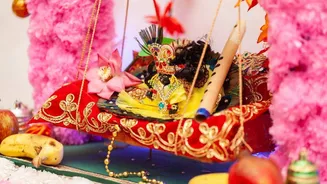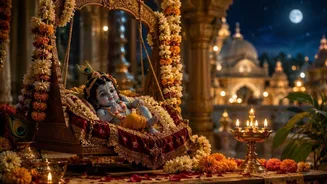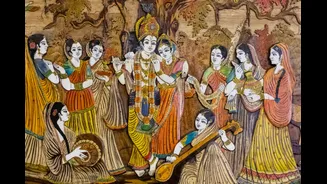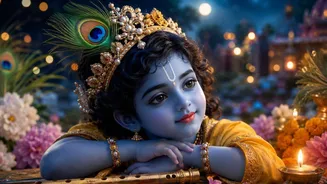





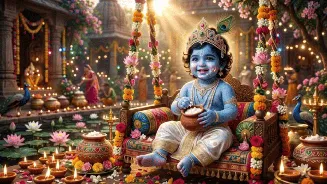

Every year on Janmashtami, homes and temples fill up with idols and pictures of Lord Krishna with a flute in hand and that famous peacock feather sitting
on his crown. It one of the most recognised symbols in Hindu tradition. But have you ever wondered why this particular bird's feather, and not a flower or a jewel, became Krishna's signature look? There is not just one answer. Over centuries, several stories have built up around this simple feather and together they tell us a lot about who Krishna is believed to represent. The Story Behind The Feather One popular legend says Krishna was once playing his flute in Vrindavan when a group of peacocks gathered around him, so moved by the music that they began dancing with joy. When Krishna stopped playing, the king of the peacocks presented a feather at his feet as a gesture of gratitude. Krishna accepted it and wore it on his head. Also Read: Janmashtami 2026: Know the Auspicious Puja Timings, Lord Krishna's Birth Muhurat and Parana Time There is another version that connects the feather to Radha. Some believe Radha once gave Krishna a peacock feather as a keepsake, and since their love is said to be eternal even though they never married, Krishna chose to wear it always as a reminder that she remains close to his heart. What Does The Feature Symbolise? Purity and self-control: Some traditions hold that the peacock is the only creature in nature known for complete chastity. Since Krishna is regarded as an eternal celibate at heart despite his many relationships, always focused on the world's welfare rather than personal pleasure, the feather is seen as a mark of that inner purity. Inner vision and wisdom: The circular "eye" at the centre of each feather is often read as a symbol of awareness that goes beyond the physical. It is said to represent Krishna's all-seeing awareness, protection from negativity, and wisdom that sees past illusion, or Maya. When Is Janmashtami 2026? There is confusion over September 4 and September 5 which is mainly because Krishna's birth is commemorated at midnight. According to the panchang, the Ashtami Tithi begins at 2:25 am on September 4 and ends at 12:13 am on September 5. The Rohini Nakshatra begins at 12:29 am on September 4 and continues until 11:04 pm the same day. Also Read: When Is The First Ekadashi Of September? Know Tithi, Shubh Muhurat And Other Important Details Keeping this in mind, Janmashtami will be celebrated on September 4, 2026. The Nishita period, which is considered the midnight period for Janmashtami worship, varies slightly from city to city. In New Delhi, the puja muhurat is around 11:57 pm on September 4 to 12:43 am on September 5. In Kolkata, it falls earlier, from 11:13 pm to 11:59 pm on September 4. Key Timings
- Janmashtami: Friday, September 4
- Ashtami Tithi begins: 2:25 am, September 4
- Ashtami Tithi ends: 12:13 am, September 5
- Rohini Nakshatra begins: 12:29 am, September 4
- Rohini Nakshatra ends: 11:04 pm, September 4
- Nishita Puja: Around midnight between September 4 and 5
- Dahi Handi: Saturday, September 5, in many places
Disclaimer: This article is based on popular beliefs. Times Now is not responsible for the accuracy or completeness of the information and facts provided here.