






What is the story about?
There are festivals that arrive with a date on the calendar, and then there is Onam, a season that seems to take over Kerala, one flower, feast and family
gathering at a time. In 2026, the most important day of the celebrations, Thiruvonam, will be observed on Wednesday, August 26. Celebrated during the Malayalam month of Chingam, Onam is Kerala’s major festival and is deeply connected with ideas of prosperity, harvest, community and homecoming. While its traditions have religious and cultural roots, the festival is celebrated across communities, making it one of the most inclusive occasions on Kerala’s calendar.
Why Is Onam Celebrated?
Onam is a very loved festival that is celebrated behind the legend of the King Mahabali who was also known to be Maveli. He was remembered in Kerala as a generous and loving ruler. According to the popular tales and stories, Mahabali's reign was known to be a golden age when his people lived happily and without discrimination. As his popularity grew, it made the gods upset and concerned. This eventually led to the arrival of Lord Vishnu in the form of Vamana. The story then proceeds when Vamana asks Mahabali for as much land as could be covered in just three steps. The king agreed and Vamana grew into a cosmic form and covered the earth along with the heavens in just two strides. With nowhere left to go for the third step, Mahabali offered his own head. He was then sent to the netherworld but was granted permission to return and visit his own people once every year. And that's what Onam is about. It is associated with annual homecoming and carries an emotional sense of welcoming where homes are cleaned, flowers are arranged and families come together to celebrate the king’s return.
What Happens During Onam?
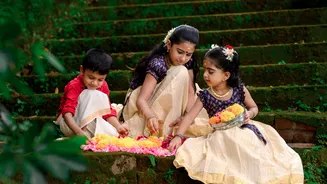
Onam celebrations traditionally unfold over several days, with Thiruvonam marking the grandest day. The festivities are associated with a sequence of ten days beginning with Atham and culminating in Thiruvonam. One of the most recognisable traditions is the pookkalam, a colourful floral arrangement created at the entrance of homes. Fresh flowers are arranged in intricate patterns, with the designs becoming increasingly elaborate as the festival approaches. It is more than decoration, it is part of the visual language of Onam and a way of preparing the home to welcome Mahabali. Then comes the part almost everyone looks forward to: Onam Sadya.
Served traditionally on a banana leaf, the vegetarian feast features an array of dishes including avial, thoran, olan, erissery, sambar, rasam, pickles and more, usually ending with the much-loved payasam. The feast is as much about sitting together as it is about the food itself. Onam also brings Kerala’s cultural traditions to life. Vallam Kali, or snake boat races, are among the festival’s biggest attractions, while music, dance, games, processions and other cultural programmes add to the celebratory mood.
The Spirit Of Onam
What makes Onam special is that its celebration extends beyond any single ritual. New clothes, floral carpets, traditional food, cultural performances and family gatherings all come together to create the unmistakable Onam atmosphere. And perhaps that is the enduring charm of the festival. Onam is about abundance, but not simply in the material sense. It is about having a full table, an open home and people around you.
As Thiruvonam arrives on August 26, 2026, Kerala will once again come alive in shades of flowers, traditional attire and festive cheer, keeping alive a story of a king whose greatest legacy, according to legend, was how deeply his people loved him.