







What is the story about?
Tucked away amid forests and low hills near Ramtek, Karpur Baoli is one of Nagpur’s most overlooked heritage sites. Quiet, weathered, and wrapped in local
legend, this ancient stepwell offers a glimpse into the region’s layered past—far from the city’s usual tourist trail.
Where Is Karpur Baoli?
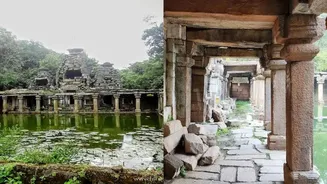
Believed to date back to between the 10th and 12th centuries, Karpur Baoli sits within the larger Ramtek temple complex. Stepwells were once a practical part of daily life in India, designed to store water for drinking, rituals, and farming. What makes this one unusual is the belief that its water level has remained unchanged since the day it was built, regardless of season or rainfall. Today, the baoli lies at the base of small hills, surrounded by dense forest.Why Is It Called Karpur Baoli?
Karpur means camphor, while baoli refers to a water tank or stepwell. According to local legends, the water here once carried a faint camphor-like fragrance and was thought to have medicinal qualities. While the scent is no longer noticeable, the name has endured for centuries.Karpur Baoli is not just a water structure but also a place of worship. The site is dedicated to six goddesses: Chamunda, Bhairavi, Ingalaj, Kali, Ranchandi, and Kapurta. A small Kali temple still stands at the edge of the stepwell. Architecturally, the baoli features a pillared corridor on three sides and the remains of a partially collapsed garbhagriha (sanctum), which once housed a deity. Though time has taken its toll, the structure still reflects the craftsmanship of its era.
Who Built Karpur Baoli?
Historians believe the stepwell was constructed during the rule of the Yadava dynasty, which controlled large parts of present-day Maharashtra between the 10th and 13th centuries. Its architectural style and layout are consistent with temple-linked water structures from that period. Despite its age, the site remains largely undocumented and lightly visited.The baoli is located about 1 km from the Shri Shantnath Digambar Jain Mandir in Ramtek. Exploring the stepwell and its surroundings usually takes around an hour. There are no formal facilities, so visitors should plan accordingly and treat the site with care. You can also visit Ramtek Fort, located on a hill nearby that offers views of the surrounding countryside, and the Khindsi Lake, which is a quick spot for boating or even a relaxed picnic.
About 30 km from Ramtek, the town of Mansar is known for ancient temples such as the Mansar Devi Temple and Lakshmi Narayan Temple, both admired for their intricate carvings and serene setting.