







What is the story about?
One picture, a million perspectives. Art is subjective for everyone—some do not see anything special in an image, while others can spend hours looking
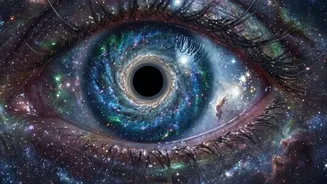
at a beautiful portrait. Little do people realise that even basic habits such as these can reveal a great deal about how one’s brain works. Here, we share an optical illusion where one can either see an eye or a galaxy. Depending on what you notice first, here is an assessment of how your brain actually works. Based on the dual perception nature of the picture, this assessment, rooted in Gestalt psychology, explains how your mind is likely to process information depending on what it notices first—the eye or the galaxy.
If you saw the eye
Noticing the eye first makes you a 'micro-thinker.' If your brain is immediately drawn to the human eye, you are more likely to focus on specific details to arrive at a larger conclusion. It indicates that you have a bottom-up way of processing information. The assessment also suggests that people who notice the eye first are more likely to be highly empathetic and perceptive of others’ emotions.
Read more: Optical Illusion Personality Test: Your Adventure Pick Reveals Who You Truly Are
Experts say that people who see the eye prominently are naturally attuned to social cues and emotional intelligence. You consider every aspect before coming to a conclusion, thereby making you analytically precise. You notice things that most people tend to miss. This suggests self-awareness and observant behaviour, which helps you lead a life guided by strong intuition and a moral compass.
If you saw the galaxy first
Noticing the galaxy first makes you a macro thinker. If you saw a swirling nebula before the eye in the image, your mind is more prone to a top-down assessment of things. You notice the bigger picture rather than smaller components. These individuals are more likely to be natural dreamers who are not interested in mundane information but in the ‘what ifs’ of every situation. They are creative and comfortable with ambiguity.
People who notice the galaxy first are less likely to be bogged down by minor setbacks or everyday drama. A cosmic perspective helps them understand that most problems are small in the larger picture of the universe. Analytically, you are able to connect the dots that many people do not even see in the first place. While others look for details, you focus on the bigger picture and come up with unique solutions to complex challenges.
Read more: This Window Optical Illusion Reveals If You’re Left-Brained or Right-Brained
Conclusion
It is noteworthy that the eye in the image is an object of focus for a mind that seeks identity and structure. On the other hand, the galaxy is linked to a mind that values possibilities and context. Being able to switch between the two indicates high cognitive flexibility and an ability to shift perspective and adapt to others’ thought processes.]