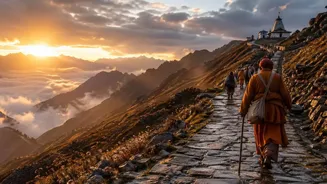







As the Char Dham Yatra gathers momentum this season, the conversation around it often centres on infrastructure - better roads, helicopter services, smoother
logistics and what not! With each passing day, the yatra is being designed to be efficient, accessible and less physically demanding. And yet, a quieter, more telling trend runs parallel to this evolution. Many of the pilgrims are actively and happily rejecting these conveniences. They walk long distances, refuse ponies and on top of that, deliberately avoid shortcuts that could make the journey easier. At first, this feels almost counterintuitive. In a world that is obsessed with comfort, why would anyone willingly opt for physical strain, especially on a spiritual journey that is so emotionally significant? But speak to those who have made that choice, and the answer is less about devotion in the traditional sense and more about experience. For them, the hardship is not a barrier but a mechanism through which it is accessed.
The Need To Earn The Experience!
For Ritu Sharma, a 34-year-old professional from Delhi, the decision to trek to Kedarnath without assistance was in no way rooted in ritual purity or external pressure. It was instinctive. "I knew I wouldn’t feel right taking a helicopter," she says. "It would feel like I just arrived, not experienced it."And here it goes: this particular distinction - between arriving and experiencing - remains the central psychology of modern pilgrims. When a journey involves physical effort and discomfort, it becomes layered. Each step simply adds narrative weight. The fatigue, the altitude and the unpredictability of the terrain - these are no longer seen as inconveniences to be eliminated but elements that somehow shape the memory.
There is also a very well-documented cognitive bias at play here, where we tend to value experiences more when they require effort. In the context of pilgrimage, that bias is just taking a deeper emotional dimension. The 16-kilometre trek to Kedarnath, for instance, is not just a route but a gradual build-up. The body slows down, and somewhere along the way, the noise of everyday life begins to recede.
"I didn't expect it to affect me mentally as much as it did,” says Ankit Mehra, a 42-year-old entrepreneur who completed the yatra on foot last year. "There is a point where your body is so tired that your mind stops jumping from one thing to another. You're just… there."
Now that "just there" feeling is hard to articulate but also instantly recognisable. It is where the spiritual dimension begins to quietly unfold. When physical exertion peaks, something else just comes down. You somehow get to experience the stillness, not imposed, but arrived at.
When The Body Slows, Mind Listens
From a spiritual perspective, the insistence on taking the harder path is not new but deeply embedded in the very idea of pilgrimage across traditions. The Sanskrit word "yatra" itself implies movement with purpose and not convenience. It is less about reaching a site and more about undergoing a transition. Walking, especially over long distances and in challenging terrain, has a way of reorganising attention. In fact, many spiritual traditions recognise repetitive physical movement as a gateway to meditative awareness."I started the trek thinking about work, deadlines, everything waiting for me back home," says Ankit. "But somewhere after a few hours, those thoughts just… dropped. I wasn’t trying to be spiritual. It just happened."
And that "just happened" is the key. Unlike any structured meditation or prayer, where stillness is intentional, the pilgrimage route somehow induces it indirectly. The body becomes the entry point, fatigue slowly strips away excess thought and discomfort demands presence. For 51-year-old homemaker Sunita Verma, who completed the yatra on foot despite her family urging her to take assistance, the shift was deeply personal. "There were moments when I wanted to stop, when I questioned why I chose this," she says. "But then there were also moments when I felt completely calm, even in the middle of the climb. Like nothing else mattered."
It Is About Intention And Not Endurance
It would be so easy to frame this as a glorification of suffering, but that would miss the nuance completely. The spiritual value of the harder path does not lie in pain but in the intention. The act of choosing effort, when ease is available, changes the quality of the experience. In earlier times, pilgrims did not have the option of helicopters or paved paths. Difficulty was inherent. Today, it is elective. And that is what makes it meaningful in a different way.Choosing to walk when one could ride, in many ways, is a conscious slowing down. In fact, it is a refusal to compress something that is meant to unfold slowly. In spiritual language, it becomes an offering, which is not necessarily to a deity, but to the experience itself. "I felt like I was giving something of myself," says Ritu. "Not in a religious way exactly, but in a personal way. Like I was showing up fully."
This idea of "showing up fully" is perhaps the closest modern articulation of what older traditions might deem devotion. It is not always expressed through rituals or prayers, but through presence, effort and attention. At the same time, there is an important distinction that needs to be made. The growing narrative around taking the tougher route can sometimes create subtle hierarchies. This is where those who walk are seen as more authentic than those who don't. But spirituality, at its core, resists such comparisons.
For some, walking the entire route may be transformative. For others, the journey might unfold differently - through quiet reflection, prayer, or even the act of simply being there. The external form varies, in all cases.
The Difference Between Reaching And Arriving
What ultimately sets apart those who choose the harder path is not just the journey but the quality of arrival. After hours, sometimes even days of walking, the destination is not just seen but felt. "There was a moment when I finally saw the temple," recalls Sunita. "I didn’t even realise I had tears in my eyes. It wasn’t dramatic, just… overwhelming."That emotional release is not incidental but built over time, through effort, anticipation and the gradual shedding of distractions. In contrast, when the journey is shortened, the arrival can feel abrupt. Efficient, yes. Comfortable, certainly. However, it often missed that slow build-up that gives the moment its depth.
This is perhaps why, even as the Char Dham Yatra becomes more accessible, many pilgrims continue to choose the longer and harder route. Not out of obligation, but out of an intuitive understanding that some experiences cannot be rushed without losing something essential. And maybe that is what these pilgrims are really seeking - not just a destination in the mountains, but a state of being that can only be reached when the body is tired, the mind is quiet, and the journey has been truly lived.