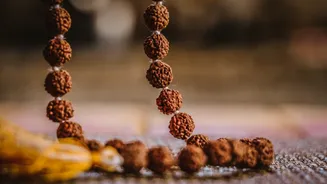








The term 'Rudraksha' is itself telling of its origins. 'Rudra' refers to Lord Shiva himself while 'aksha' refers to his tears. Rudraksha beads then stand
to represent the blessings of His endless tapasya. Authentic Rudraksha beads grow on the Rudraksha tree, native to the central region of Nepal and the Gangetic plains for the foothills of the Himalayas and are covered by a blue outer shell. Each bead has natural grooves running down it vertically - called mukhi - and this becomes the defining basis of the exact type of Rudraksha beads. It takes 10 to 12 years for the Rudraksha to mature and bear fruits which when ripened, are then placed in water for a few days following which the pulp is taken off to reveal the bead. A Rudraksha bead can have a singular mukhi or as many as 21. As a matter of fact, more recently, Rudraksha beads with more than 21 mukhis have also been found - though the ancient texts bear no mention of them.
Rudrkasha Beads are Not Just Indian
Besides the Rudraksha beads available in India, there are also those sourced from Nepal and Indonesia. Though the internal structures of these varieties are largely similar, Nepalese Rudraksha beads are slightly more glossier and larger in size. Indonesian Rudraksha beads on the other hand - called 'Java' - are smaller. Their origin aside, the true determining factor of the spiritual potency of Rudraksha beads is the amount of mukhis they carry. The Rudraksha beads with mukhis between 1 to 21 are the primarily relevant ones, some being more sought after than others.
Decoding the Mukhis
The Rudraksha beads with a singular mukhi are believed to be ruled by Lord Shiva and are compatible with all ruling planets. This is believed to balance and restore the Crown Chakra.
The Rudraksha beads with dual mukhi are ruled over by Ardhanareshwar with the moon as the presiding planetary body. This is good for those looking to tap some unity and harmony into their lives.
The three-mukhi Rudraksha beads are presided over by Agni - the God of Fire - with the Sun as the presiding planetary body. Wearing this Rudraksha is believed to free one from their past karmas.
The four-mukhi Rudraksha is presided over by Brihaspati with Jupiter as the ruling planet. This Rudraksha improves knowledge and creativity.
The five-mukhi Rudraksha is ruled by Rudra Kalagni with Jupiter again, as the ruling planet. This Rudraksha bead is considered particularly auspicious and is a good fit for those attempting to achieve their highest selves.
The six-mukhi Rudraksha has Kartikeya as the ruling God with Mars as the ruling planet. This bead is appropriate for those who are seeking the fulfillment of their desires.
The seven-mukhi Rudraksha is presided over by Goddess Lakshmi with Venus as the ruling planet. Having this on one's being blesses the wearer with health, wealth and new prosperous opportunities.
The eight-mukhi Rudraksha is presided over by Lord Ganesha with Ketu as the presiding planetary body. This Rudraksha bead is believed to carry the 'Vignaharta' energy of Lord Ganesha Himself. The same goes for the nine-mukhi Rudraksha, presided over by Maa Durga with Rahu as the presiding planetary body. This Rudraksha bead imbibes the wearer with a sense of fearlessness, quite like Maa Durga herself. Finally, the ten-mukhi Rudraksha is presided over by Lord Krishna with the energy of all the planets. This is a good fit for those who strive to achieve peace.
Increasing number of mukhis make the rudras rarer though each is associated with a very specific Lord, planet and purpose.