






The Tallest Titans
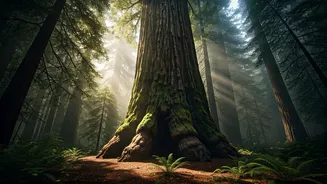
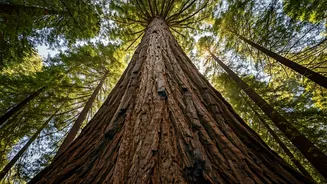
The undisputed champions of vertical growth are the Coast Redwoods (Sequoia sempervirens), native to California. These magnificent conifers are celebrated
as the tallest trees on Earth, with some specimens, like the renowned Hyperion, soaring to astonishing heights exceeding 115 meters (379 feet). Their slender yet imposing forms dominate the coastal forests, creating awe-inspiring natural cathedrals. Scientists estimate that trees, in general, may possess a theoretical maximum height ceiling somewhere between 122 and 130 meters, a limit these redwoods push close to. Their rapid growth rate and enduring presence make them a vital part of their ecosystem and a testament to nature's potential for grandeur. These giants are a breathtaking sight, offering a humbling perspective on our place in the natural world.
Massive by Volume
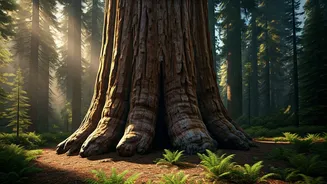
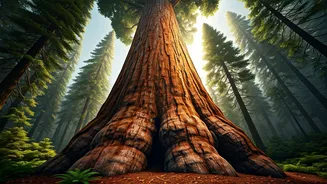
While not reaching the extreme heights of their redwood cousins, Giant Sequoias (Sequoiadendron giganteum) hold the title for the most massive trees by volume. These ancient giants, also found in California, boast incredibly thick trunks and an unparalleled capacity for biomass. Their sheer scale is staggering, with individual trees containing enormous amounts of wood, making them some of the largest living organisms on the planet. Their longevity is as impressive as their girth, with many individuals living for thousands of years. These trees are living monuments, embodying resilience and the slow, steady accumulation of immense natural power over vast stretches of time. Visiting a grove of Giant Sequoias is an unforgettable encounter with living history and geological scale.
Douglas Fir's Domain
The Douglas Fir (Pseudotsuga menziesii) is another remarkable conifer, predominantly found across North America. This species is known for its vigorous growth and its significant height potential, making it a highly valued timber resource. While not typically reaching the dizzying heights of the Coast Redwood, Douglas Firs can still achieve impressive stature, often forming substantial forests. Their adaptability allows them to thrive in a variety of conditions, contributing to their widespread distribution and importance in forestry. These trees represent a balance of rapid development and robust timber quality, showcasing a different facet of arboreal magnificence. Their presence signifies healthy, thriving forest ecosystems and a valuable natural resource.
Australia's Tallest Bloom
Hailing from Australia, the Mountain Ash (Eucalyptus regnans) stands out as the tallest flowering plant species on Earth. This impressive eucalyptus can readily surpass heights of 100 meters, a truly remarkable feat for a flowering tree. Its towering presence dominates the Australian landscape, contributing significantly to the unique biodiversity of the region. These trees are not only visually striking but also play a crucial role in their environment, supporting a wide array of wildlife. The Mountain Ash demonstrates that impressive height is not exclusive to conifers, showcasing the botanical diversity of record-breaking flora. Its sheer verticality is a breathtaking spectacle, a testament to the vigorous growth potential within the plant kingdom.
Pacific Northwest Majesty
Along the cool, moist coastlines of North America, the Sitka Spruce (Picea sitchensis) thrives, reaching exceptional heights. This hardy conifer is well-adapted to its environment, flourishing in the abundant rainfall and temperate climate characteristic of the Pacific Northwest. Its ability to grow tall and robust makes it a prominent feature of these coastal forests. The Sitka Spruce contributes significantly to the ecological richness of its habitat, providing shelter and sustenance for numerous species. Its towering form is a symbol of the enduring strength and beauty found in these northern forests. These magnificent trees are a testament to the power of adaptation and the productivity of a well-suited environment.
Southeast Asian Giant
Venturing into the dense rainforests of Southeast Asia, we encounter the Yellow Meranti (Shorea spp.). This tropical hardwood is recognized for its impressive stature, standing tall amidst the lush canopy. Its presence signifies the extraordinary biodiversity and scale of these ancient rainforest ecosystems. These trees contribute to the complex web of life in their environment, providing crucial habitat and resources. The Yellow Meranti exemplifies the grandeur of tropical flora, demonstrating that remarkable height is a characteristic found across diverse climates and continents. Its towering form is a vital component of the rainforest's majestic structure and ecological health.