






Giants of the Savanna: The Ostrich
The ostrich, a true titan of the avian world and the largest bird on Earth, hails from Africa. While it possesses wings, they are not for soaring through
the skies. Instead, these magnificent creatures are masters of terrestrial locomotion, relying on their immensely powerful and robust legs to achieve astonishing speeds across the ground. These formidable limbs are their primary means of escape from predators and are also utilized in intricate courtship rituals. The wings, though incapable of flight, play a crucial role in maintaining balance during rapid sprints and during their elaborate mating displays, showcasing a remarkable re-purposing of avian anatomy for life on the savanna.
Down Under's Swift Runner: The Emu
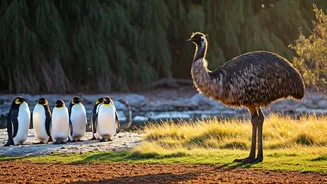
Hailing from the vast landscapes of Australia, the emu is another impressive example of a large, flightless bird. Its existence is a testament to evolutionary adaptation, focusing on ground-based mobility. Emus are equipped with strong, muscular legs that enable them to traverse significant distances with remarkable speed and agility. Their small, rudimentary wings are entirely insufficient for lifting their substantial bodies off the ground, leading them to exclusively utilize their powerful legs for movement. This reliance on swift running makes them adept at navigating their expansive Australian habitat, finding food, and evading danger in a land where flight is not a necessity for survival.
New Zealand's Nocturnal Wonder: The Kiwi
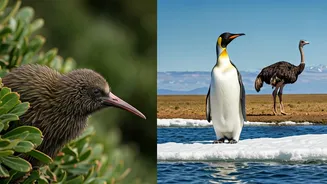
The kiwi, an emblem of New Zealand's unique biodiversity, presents a distinct evolutionary path among flightless birds. This creature is characterized by its unique, hair-like plumage, robust legs built for terrestrial activity, and a compact body that houses greatly reduced wings. Its entire physiology is geared towards a life spent on the forest floor. The kiwi is primarily nocturnal, foraging for insects and other invertebrates in the rich soil and leaf litter. Its adaptation to this ground-dwelling lifestyle, including a keen sense of smell to locate food in the dark, highlights how flightlessness can lead to specialized niches within an ecosystem.
Masters of the Ocean: Penguins
Penguins represent a spectacular evolution where flight has been completely traded for unparalleled prowess in aquatic environments. These flightless seabirds, predominantly found in the Southern Hemisphere, have transformed their wings into powerful flippers, expertly designed for navigating the ocean depths. Their bodies are streamlined for efficient swimming, and their dense bones help them dive. Adapted for life in cold, marine ecosystems, their physical attributes are optimized for hunting fish and other prey beneath the waves, demonstrating a remarkable adaptation to an environment vastly different from the skies typically associated with birds.
The Forest's Striking Dweller: Cassowary
The cassowary, a striking and powerful flightless bird, inhabits the dense rainforests of the Australo-Papuan region. Renowned for its formidable legs, which are capable of delivering dangerous kicks, and its robust build, this bird is a quintessential ground-dweller. Despite possessing wings, they are ornamental rather than functional for flight. The cassowary is exceptionally adapted to moving through thick jungle terrain, utilizing its powerful legs to navigate obstacles and forage for fallen fruits. Its distinctive appearance and ground-centric lifestyle make it one of the most iconic and intriguing species within its habitat.
South America's Speedy Runner: The Rhea
The rhea, a large flightless bird native to the open grasslands and savannas of South America, shares a kinship with ostriches and emus. Its evolutionary journey has favored speed and agility over aerial capabilities. Rheas possess long, slender legs and a relatively lightweight frame, making them exceptionally well-suited for running. This ability to cover ground rapidly is their primary defense mechanism against potential predators in their expansive, open environments. They navigate their habitat with grace and speed, a clear adaptation to a life where swift movement is paramount for survival.
New Zealand's Rare Parrot: The Kakapo
The kakapo, an extraordinary and critically endangered flightless parrot from New Zealand, represents a truly unique evolutionary offshoot. Unlike most parrots that are arboreal and aerial, the kakapo is predominantly nocturnal and ground-dwelling. Its inability to fly has contributed to its vulnerable status, making it a species of significant conservation concern. This bird spends its life foraging on the forest floor and in low vegetation. Its existence underscores the diverse pathways evolution can take, even within a seemingly familiar bird family like parrots, leading to species that have completely redefined their ecological roles.