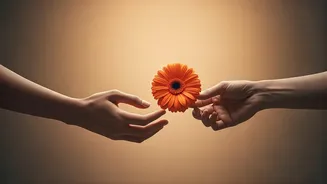








The Frequent Crier
The author recounts a personal experience of being questioned by their partner about their tendency to cry during films, even those that aren't overtly
sad. This includes a vivid description of being moved to tears by a heartwarming video of an elderly man spontaneously dancing in an Italian piazza, eventually drawing others into his joyful movement. This anecdote sets the stage for an exploration of a deeply ingrained emotional responsiveness that extends beyond media consumption to encompass online interactions, historical narratives, and acts of kindness. The author expresses a growing acceptance of this trait, viewing it not as a flaw, but as an integral and honest aspect of their personality, perhaps even a superpower when viewed optimistically. This profound emotional engagement, a stark contrast to nonchalance, is portrayed as a fundamental characteristic that influences how they experience and connect with the world around them, embracing love with their whole heart and seeing this sensitivity as a valuable perspective gained with age.
Expert Insight on Tears
Seeking to understand this heightened emotional response, the author consults with Clinical Psychologist Mehezabin Dordi. Dordi clarifies that frequent crying is often misconstrued as fragility, but clinically, it signifies a more attuned and perceptive emotional system. Individuals who are easily moved by films, strangers' stories, or ephemeral moments are not necessarily overreacting; instead, they are processing emotional stimuli with greater depth and speed. This sensitivity can be linked to a heightened emotional or sensory processing sensitivity, where the nervous system is more finely tuned to subtle cues, meaning, and connection. The psychologist emphasizes that what is frequently labeled as 'too sensitive' often represents a different threshold for emotional activation. Crying, in this context, is not a loss of control but a regulatory mechanism that triggers the body's calming response, releases stored tension, and aids in integrating experiences. Those who permit themselves to cry often navigate emotions more effectively than those who suppress them. The notion that someone cries 'at everything' rarely stems from the immediate trigger alone; it's frequently the nervous system releasing cumulative stress or unaddressed feelings. Therefore, tears are presented as a testament to the body's inherent honesty, rather than a sign of weakness.
Societal Framing of Sensitivity
Beyond the personal implications, the article addresses the societal framing of sensitivity, particularly for women, noting it has never been a neutral characteristic. Expressing emotions visibly, weeping openly, or admitting to being touched by a simple scene like a spontaneous dance in a town square has historically been perceived as a liability. This tendency to be 'too emotional' or 'too much' is something individuals often learn to apologize for from an early age. The author reflects on how this perception conveniently serves a world that functions more smoothly when individuals refrain from expressing strong emotions. Environments that prioritize high performance, such as workplaces and social circles, and the general pursuit of appearing competent, have historically shown little tolerance for emotional expressiveness. However, as Dordi points out, the very qualities that define a frequent crier—empathy, relational depth, and self-awareness—are precisely those that contribute to being genuinely effective and compassionate in human interactions. This shift in perspective is not merely a personal adjustment but carries a quiet political dimension, challenging established norms about emotional display and competence.
Reclaiming Emotional Expression
The intersection of the personal and the political is found not in grand pronouncements but in a subtle, internal renegotiation. For the author, this process began with small acknowledgments, like offering a disclaimer before watching a movie, which was initially framed as an apology. Through the act of articulating this, a realization emerged: they had long perceived their own emotional life as a disadvantage. The author expresses uncertainty about whether they will ever cease to be someone who cries easily, and more importantly, whether they even wish to. There's a clarity in navigating the world with a fully engaged nervous system, allowing experiences—like the sight of strangers dancing in an Italian town square at golden hour—to resonate with their full impact. The ultimate aspiration was never to diminish emotional experiences, but rather to embrace them without shame. Through a combination of personal reflection, such as a movie night disclaimer, and the insightful words of a psychologist, the author believes they are finally arriving at a place of self-acceptance and emotional liberation.