






Solar Wind's Dance
The sun is a dynamic entity, constantly releasing streams of charged particles known as solar wind. When these energetic particles, often originating from
vast regions called coronal holes, are directed towards Earth, they can interact with our planet's magnetic field. This interaction can lead to disturbances in the magnetosphere, triggering geomagnetic storms. The intensity of these storms dictates how far south the aurora can be seen. For instance, a G1-class storm indicates minor activity, typically confining auroras to high latitudes, while a G3 or G4 storm suggests moderate to strong activity, potentially allowing visibility much farther south, even in places like New York or Illinois. Understanding these solar wind patterns is crucial for predicting aurora appearances. Fast solar wind streams, in particular, are a primary driver for enhanced geomagnetic conditions and thus, more spectacular aurora displays. The speed and density of these streams, along with the orientation of the sun's magnetic field, all play a role in determining the strength and visibility of the aurora.
CMEs: Cosmic Explosions
Coronal Mass Ejections (CMEs) are massive eruptions from the sun's atmosphere, releasing vast quantities of plasma and magnetic fields into space. When a CME is directed towards Earth, it can significantly impact our planet's magnetosphere, often leading to more intense geomagnetic storms than those caused by solar wind alone. These 'cannibal' solar storms, or the impact of multiple CMEs, can generate particularly strong aurora activity, sometimes classified as G3 (Strong) or even G4 (Severe) events. The NOAA Space Weather Prediction Center monitors these events closely, issuing watches and warnings to alert aurora enthusiasts. The timing and trajectory of CMEs are critical; a direct hit can result in a more profound geomagnetic storm, while a glancing blow might only cause minor disturbances. Predicting CME arrival times, typically a few days after eruption, allows forecasters to estimate the potential for aurora visibility, sometimes stretching to mid-latitudes. The strength of the CME, its magnetic orientation, and its speed all contribute to the resulting aurora display, making them a key factor in aurora forecasting.
Forecasting the Aurora
Predicting aurora appearances involves understanding various solar phenomena and their impact on Earth's magnetosphere. Space weather forecasters, including those at NOAA's Space Weather Prediction Center and the UK Met Office, utilize data from satellites and ground-based observations to issue forecasts. Key metrics like the Kp-index, which measures geomagnetic activity on a scale from 0 to 9, help gauge the potential for aurora visibility. A Kp-index of 4 or 5, for example, suggests minor storm conditions and a possibility of auroras at higher latitudes, while a Kp-index of 6 or 7 indicates moderate to strong storms, allowing for visibility much farther south. Forecasters also monitor for Earth-facing coronal holes and CMEs, providing watches and warnings for potential geomagnetic storms. Factors like local darkness, clear skies, and minimal light pollution are also essential for successful aurora viewing. Apps like 'My Aurora Forecast & Alerts' and 'Space Weather Live' provide real-time data and localized predictions, empowering aurora chasers to maximize their chances of witnessing this breathtaking natural phenomenon.
Viewing the Northern Lights
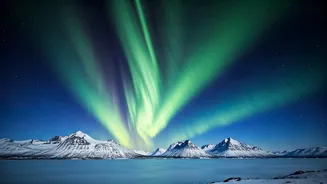
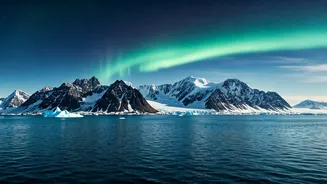
Witnessing the aurora borealis is an unforgettable experience, and knowing when and where to look can significantly enhance your chances. The best viewing times are typically during periods of heightened geomagnetic activity, often coinciding with minor to strong geomagnetic storms (G1 to G3 levels). While auroras are most commonly observed in polar and high-latitude regions, such as Alaska, Canada, or Scandinavia, stronger solar events can push the auroral oval much farther south, making them visible in unexpected locations like Illinois, Oregon, or even New York. Winter months, with their longer nights, generally offer better viewing conditions, especially in the Southern Hemisphere. However, even during summer, brief displays can occur. When hunting for the aurora, seek out locations away from city lights to minimize light pollution. Checking real-time aurora forecasts and Kp-index predictions from reliable sources like NOAA's Space Weather Prediction Center is crucial. Remember to also consider local weather conditions; clear, dark skies are paramount for optimal viewing. Patience is also key, as auroral displays can be intermittent and unpredictable.