

Joynagar-er Moa: A Winter's Delight
Hailing from Joynagar, this unique sweet boasts a Geographical Indication (GI) tag, making it exclusively authentic to its origin. Its creation relies
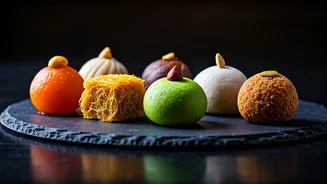
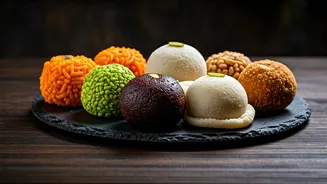
on two seasonal, hyper-local ingredients: Kanakchur paddy's khoi, harvested only in winter, and the treasured nolen gur, date palm jaggery that flows during the colder months. The resulting texture is remarkably soft and light, melting in the mouth with a distinct smoky, caramel-like sweetness, a stark contrast to the flat sweetness of mass-produced items. Its extremely short shelf life and the meticulous craft of balancing ingredients to achieve the perfect consistency without density underscore its special appeal, driving locals to eagerly await winter just for this ephemeral treat. The process, while seemingly simple—binding khoi with molten nolen gur and shaping—requires generations of perfected skill to get the ratios just right.
Jolbhora Sandesh: A Sweet Surprise
Jolbhora Sandesh presents an intriguing duality, appearing as a typical, subtly molded pale sandesh from the outside. However, its name, translating to 'water-filled,' hints at the delightful secret within: a burst of sweet syrup upon biting. Traditionally, this liquid core is rose syrup or nolen gur, ingeniously sealed within the soft chhena exterior. The mastery lies in crafting the sandesh to hold this syrupy center intact until the very first bite, creating a captivating contrast in textures. Achieving this requires significant patience and skill, beginning with a firm chhena dough with minimal sugar to prevent collapse. The dough is shaped into a cup, filled with the syrup, and then carefully sealed and molded. The chhena must be kneaded to a pliable state without becoming greasy. Chilling before serving is crucial. The entire art of Jolbhora Sandesh rests on the precise sealing, ensuring the surprise remains for the consumer.
Langcha: The Elongated Fried Sweet
Originating from Saktigarh, Langcha is a long, deep-fried Bengali sweet that offers a distinct experience compared to its rounder cousin, the gulab jamun. Crafted from chhena and flour, it's fried to a rich brown hue before being immersed in sugar syrup. This soaking process renders it soft while retaining a subtle chewiness. Its elongated shape provides a greater surface area for syrup absorption, leading to more caramelized crust with every bite. The flavor profile leans towards a deep, caramelized richness from the frying, delivering an intense sweetness. Unlike gulab jamun, the higher chhena content in Langcha imparts a slightly tangier, less uniform sweetness. Preparation involves kneading chhena and maida with a touch of baking soda until smooth, shaping into oblongs, slow-frying to a deep brown, and then soaking in warm, cardamom-flavored sugar syrup for at least 30 minutes. Crucially, the slow frying prevents the surface from cracking before the interior cooks.
Mihidana & Sitabhog: A Perfect Pair
These two distinct sweets, both from Burdwan and bearing their own GI tags, are often presented together, their unique qualities complementing each other. Mihidana, resembling tiny golden grains, is incredibly soft and lightly sweet, practically dissolving on the tongue. It's essentially a super-fine version of boondi, made by dripping besan batter into hot ghee, with the resulting droplets immediately transferred to sugar syrup. The batter consistency is key for clean droplet separation. Sitabhog offers a textural contrast, appearing like fragrant white rice but entirely sweet. It's crafted from fine strands of rice flour and chhena, often adorned with small fried pieces. The preparation of Sitabhog is intricate: rice flour and chhena are cooked into a smooth dough, then passed through a sevania press into boiling sugar syrup to form the delicate rice-like strands. This sweet demands a remarkably steady hand. Together, Mihidana and Sitabhog create a layered sensory experience, showcasing Bengali confectionary's finesse in texture and taste.
Lobongo Latika: Cloved Sweet Parcel
Typically prepared during auspicious periods like Durga Puja or Makar Sankranti, Lobongo Latika is a festive sweet resembling a carefully wrapped parcel. It features a thin dough casing encasing a rich, kheer-like filling made from khoya, sugar, cardamom, and sometimes grated coconut. This parcel is folded neatly and secured with a clove (lobongo), which imparts a subtle spicy note. After deep-frying to a golden crisp, it's soaked in sugar syrup, resulting in a delightful contrast between the crisp exterior and soft, luscious interior. The flavor is a harmonious blend of sweetness with a hint of spice, offering a comforting taste. The dough is a simple maida mixture enriched with a bit of ghee, rolled thin, filled, folded like an envelope, and sealed with a clove. The clove's role extends beyond sealing, cutting through the sweetness with a gentle warmth that makes this sweet truly unique.
Shor Bhaja: Artisanal Cream Layers
Shor Bhaja is a testament to meticulous Bengali sweet-making, involving the careful collection and layering of milk cream. These cream layers are then folded, shaped, and deep-fried to a golden perfection before a brief dip in sugar syrup. This process yields a sweet with a unique texture: an exterior that is delightfully crisp, giving way to an interior that is rich and velvety. It offers an indulgent experience without being overly sweet, positioning it as one of Bengal's most artisanal and rare confections, usually reserved for special occasions. Its creation demands considerable patience, starting with heating full-fat milk on very low heat to allow cream films to form. These films are collected over several hours, layered, cut into rectangles, gently fried in ghee, and then briefly soaked in thin sugar syrup. The result is a creation akin to a fried cream or a delicate pastry, a treat that cannot be rushed and whose rarity enhances its value.
Patishapta: The Stuffed Crepe
Patishapta is a cherished sweet, traditionally made on Poush Sankranti or Makar Sankranti, embodying Bengal's unique take on a stuffed crepe. The batter is a blend of rice flour, maida, and semolina, thinned with milk to a pourable consistency, then spread thinly onto a lightly greased pan. The star of the Patishapta is its filling: freshly grated coconut cooked down with nolen gur until dry and fragrant, often enriched with a bit of khoya. The warm crepe is then folded around this luscious filling. What makes Patishapta particularly appealing is the delightful interplay between the slightly chewy crepe and the gooey, jaggery-sweetened coconut. When made with nolen gur, the sweet carries an intoxicating aroma of caramel with an earthy, smoky undertone unmatched by refined sugar. As a beloved home-style sweet, it holds a personal significance for many who grew up enjoying its comforting flavors.