






Revolutionary Laser Comms
The Artemis II mission is not just a historic return to the Moon; it's also a critical testbed for a groundbreaking communication technology. Unlike the radio
frequencies that have long been the workhorse of space communication, this new system, known as the Orion Artemis II Optical Communications System (O2O), utilizes infrared laser light to ferry data between the Orion spacecraft and Earth. This innovative approach dramatically boosts data transfer rates, reaching an impressive downlink speed of up to 260 megabits per second and an uplink of 20 megabits per second. This stands in stark contrast to the considerably slower bandwidth offered by traditional radio-frequency systems, which are also facing increasing congestion in the crowded electromagnetic spectrum. O2O represents the first deployment of laser communications technology on a crewed mission venturing to the lunar vicinity, marking a significant technological advancement for deep space exploration and paving the way for more robust and efficient data exchange in the future.
The MAScOT System
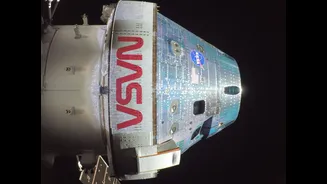
At the heart of this advanced communication capability is a sophisticated terminal dubbed MAScOT, which stands for Modular, Agile, Scalable Optical Terminal. Developed collaboratively by MIT Lincoln Laboratory and NASA's Goddard Space Flight Center, MAScOT is engineered to be remarkably compact yet powerful. It's designed to be mounted externally on the Orion spacecraft and features a primary 4-inch (10-centimeter) telescope. This telescope is precisely affixed to a two-axis gimbal, granting it the ability to swivel across a vast hemispherical range. This extensive range is crucial for its operation, allowing it to accurately acquire and maintain contact with ground stations situated in various locations, including New Mexico and California in the United States, as well as an experimental facility in Australia to ensure coverage of the southern hemisphere. Accompanying the telescope is a separate optical assembly, housing an array of vital components such as light-focusing lenses, sophisticated tracking sensors, rapid-response mirrors for fine adjustments, and other precision-pointing mechanisms. These elements work in concert to concentrate the laser beam onto a target that can be hundreds of thousands of miles away, ensuring a stable and focused connection across immense distances.
Mastering the Aim
While generating the powerful laser signal is relatively straightforward, the truly monumental engineering challenge lies in precisely aiming it. The sheer distance involved in deep space communication means that even a laser beam, when it travels the approximately 238,855 miles from Orion to Earth, will expand considerably, reaching a diameter of about 6 kilometers (3.7 miles). To successfully hit the relatively small aperture of a ground station within this expansive footprint, an astonishing level of pointing accuracy is required—on the order of one-thousandth of a degree. This level of precision is akin to trying to track a moving coin from a mile away with a simple tool. Achieving this pinpoint accuracy necessitates an extremely precise understanding of Orion's exact position and orientation in space at any given moment. While star trackers provide essential attitude data, subtle misalignments can occur in the vastness of space due to thermal fluctuations and structural flex on the spacecraft. These shifts can create discrepancies between the star tracker's reference frame and the physical alignment of the MAScOT terminal. Calibrating and compensating for these offsets while the spacecraft is in flight is a critical task. Furthermore, the presence of Orion's solar arrays and the spacecraft body can create potential obstructions, and uncertainties in maintaining the vehicle's orientation add further layers of complexity that can only be fully addressed and resolved through actual spaceflight operations.
Immediate and Future Benefits
The immediate and most tangible advantage of this advanced laser communication system is the ability to transmit high-definition video in real-time. Astronauts can now send back vibrant 4K footage, stunning photographs, critical scientific data, and clear voice communications—capabilities that were simply unattainable with the bandwidth limitations of traditional radio systems alone. Beyond the enhanced real-time data, O2O also addresses a long-standing logistical challenge in crewed spaceflight: the delayed analysis of flight recorder data. Historically, vital telemetry and operational data remained stored onboard the spacecraft until the mission concluded and the vehicle splashed down. This often meant that crucial information could take months to be retrieved and analyzed. With O2O's peak downlink rate, all of the data generated on Orion's first day in space could theoretically be transmitted back to Earth within a matter of hours, significantly accelerating scientific discovery and mission analysis. Looking further ahead, the O2O system unlocks the potential for truly real-time, two-way communication. Even with the approximately one-second round-trip delay inherent in communication from lunar distances, the connection is stable and responsive enough to support activities like video conferencing, making interactions between astronauts and ground control more dynamic and efficient.