






The "Next Thing" Trap
Many of us fall into a pattern of living for future achievements, believing happiness lies solely in reaching distant milestones like promotions, relationships,
or career successes. This relentless pursuit of 'the next thing' can lead to a life spent in a perpetual state of waiting, diminishing the value of our present experiences. Tim Cook's simple yet powerful message encourages a recalibration of our focus, urging us to appreciate the 'how' of our endeavors rather than solely fixating on the 'where.' This perspective shift is crucial because if our contentment is perpetually deferred to a future outcome, we risk overlooking the continuous opportunities for joy and growth that exist right now. By recognizing this tendency, we can begin to break free from the cycle of postponed happiness and start living more fully in the moment.
Conditioned for the Finish Line
From an early age, our societal conditioning often emphasizes outcomes and results. We are taught that success is defined by achieving specific benchmarks: good grades lead to good jobs, hard work leads to financial stability, and continuous effort eventually culminates in 'making it.' This constant focus on a 'finish line' can distort our perception, leading us to view the path to our goals as merely a series of obstacles to endure rather than an integral part of the experience. While goals are undeniably important for providing direction and motivation, the overemphasis on the end result can cause us to devalue the present. Life, however, is not solely composed of grand achievements; it is predominantly built from the fabric of ordinary, everyday moments. Failing to find contentment in these smaller, often mundane experiences means we are essentially skipping over the majority of our lives.
Life Unfolds in the Journey
At its core, the distinction between a goal and a journey is a matter of perspective and timing. A goal represents a singular point in time, a destination reached. Conversely, the journey encompasses the entire duration leading up to that point, encompassing all the actions, learning, setbacks, and growth that occur along the way. Consider the pursuit of a desired job: the journey involves the interviews, the skills acquired, the inevitable failures, and the resilience built. Similarly, a fulfilling relationship is cultivated through countless conversations, mutual understanding, and shared personal development. Even physical fitness, often seen as a singular goal, is fundamentally a journey defined by consistent workouts, the discipline required, and the mental fortitude to persevere on days lacking motivation. The transient nature of goal-achieved happiness—a brief celebration followed by the pursuit of the next objective—underscores the importance of finding fulfillment in the process. If we continually postpone joy until we arrive, we risk an eternity of chasing happiness without ever truly experiencing it.
The Transformative Power of Process
When we cultivate an appreciation for the journey, our perception of challenges and efforts undergoes a profound transformation. Tasks are no longer viewed as mere work but as opportunities for learning and development. Struggles become catalysts for personal growth, and periods of waiting transform into active living. This shift doesn't necessarily make life effortless, but it imbues every experience with greater meaning. Even difficult days are reframed; instead of succumbing to a victim mentality with 'Why is this happening to me?', we can adopt a proactive stance, asking 'What is this teaching me?' This internal dialogue fosters resilience and a more constructive approach to adversity. Embracing the journey allows us to see the value in every step, recognizing that progress is often incremental and that even seemingly stagnant periods contribute to our overall development.
Journeying Without Constant Bliss
It's essential to clarify that finding joy in the journey does not equate to perpetual happiness or an absence of negative emotions. Life inherently includes moments of fatigue, frustration, and uncertainty, and these are valid experiences. The principle is not to eliminate these feelings but to avoid labeling these days as wasted or as impediments to progress. Personal growth is often a messy, nonlinear process, and progress can sometimes feel slow. However, by seeking out and acknowledging even minor moments of satisfaction—completing a small task, acquiring a new piece of knowledge, or simply committing to show up—we are actively engaging with the spirit of enjoying the process. These small victories, when recognized, contribute to a more balanced and realistic approach to personal development, acknowledging that challenges are an integral part of the path forward.
A Travel Analogy
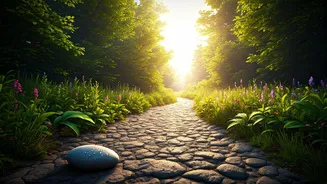
To better grasp this concept, consider the act of travel. If one were to meticulously plan a trip with the sole declaration, 'I will only be happy once I reach the destination,' it would seem quite peculiar. The true essence of traveling lies in the multifaceted experience—the breathtaking views, the unique culinary discoveries, the interactions with local people, and the spontaneous, often unexpected moments that arise. Life functions in a remarkably similar fashion. When our sole focus is on 'arriving' at a particular point, we risk completely missing out on the richness and depth of the experiences that unfold in the interim. The journey itself, with all its nuances and unfolding events, is where life is truly lived and savored.
Social Media's Distortion
The prevalent influence of social media presents a significant challenge to cultivating a mindset centered on enjoying the journey. Platforms are saturated with curated 'end results'—highlight reels of others' successes: promotions, new homes, marriages, and perceived achievements. This constant exposure can inadvertently foster a sense of inadequacy and pressure, creating the illusion that we are falling behind. We often fall into the trap of comparing our behind-the-scenes struggles and imperfections with others' polished public personas. This comparison is inherently unfair and ultimately unproductive, as it neglects the invisible processes, the inevitable setbacks, and the internal doubts that accompany every significant endeavor. Understanding this dynamic is crucial for maintaining a healthy perspective on our own progress.
Embracing Your Path
Adopting a more process-oriented approach to life doesn't necessitate radical upheaval; rather, it involves subtle yet impactful adjustments to our daily awareness. Simple practices like intentionally slowing down and resisting the urge to rush every task can make a difference. Actively acknowledging and celebrating small victories—whether it's completing a task or simply showing up consistently—validates our efforts. We should also try to let go of the pursuit of 'perfect' moments, as they are often elusive. Cultivating presence, even in mundane activities, and consciously giving ourselves credit for our progress, recognizing that we are often doing better than we perceive, are key to embracing the journey. It’s about developing a slightly more mindful engagement with our everyday existence, finding value in the continuous unfolding of our lives.
The Deeper Significance
Tim Cook's quote offers a profound insight into the nature of lasting contentment. By suggesting we find joy in the journey rather than deferring it to a distant goal, he essentially advises us not to put our happiness on indefinite hold. Continuously chasing future aspirations without appreciating the present can lead to an endless cycle of pursuit. However, learning to appreciate our current circumstances, even amidst imperfections, fosters a sense of grounding and inner peace. This enables us to transition from rushing through life to truly living it. While goals will always emerge and evolve, it is the journey—the present moment, the effort exerted, and the seemingly insignificant days—that constitutes the substance of our existence. Therefore, instead of fixating on a far-off finish line, we should seek out and cherish even the smallest elements of our day that bring us joy. Ultimately, life's value is measured not just by where we end up, but by the richness and fulfillment we experience along the way.