


The Soggy Bottom Blunder
It's a common culinary disappointment: meticulously frying chicken or fritters to golden perfection, only to have them lose their satisfying crunch the moment
they're placed on a plate. This often happens because traditional methods, like draining on paper towels, create a moisture trap. When hot fried food sits on a flat surface, residual oil and steam get trapped beneath it, essentially steaming the crust and undoing all your hard work. This leads to greasy, unappealing results, transforming what should be a delightful delicacy into a disheartening experience. The core issue isn't just the frying process itself, but rather what happens immediately after the food leaves the hot oil.
The Wire Rack Revelation
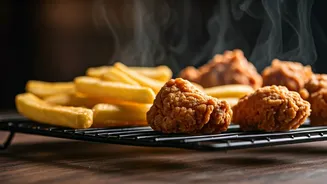
The culinary world has a simple, yet remarkably effective, solution: ditch the plates and embrace the wire rack. This straightforward switch after frying is the key to achieving that coveted crispness, mimicking professional kitchens. By elevating your fried items onto a wire rack, you allow air to circulate freely around them. This ventilation is crucial, as it prevents the build-up of steam and allows excess oil to drip away unimpeded. The result is a consistently crunchy exterior that maintains its integrity, elevating your homemade fried dishes from merely good to exceptionally delightful. It's a small change with a monumental impact on texture.
Understanding Oil Absorption
Surprisingly, a significant amount of oil absorption in fried foods doesn't occur during the cooking process itself, but rather during the cooling phase. When food emerges from hot oil, its outer crust cools rapidly. This temperature drop causes a reduction in internal pressure, creating a subtle vacuum effect. This vacuum then draws surface oil deeper into the porous structure of the food. Research highlights that the very nature of the fried surface acts as a primary conduit for this oil diffusion. Therefore, managing the post-frying treatment is paramount in controlling the final fat content and ensuring a less greasy outcome.
Gravity and Oil Separation
The orientation of your fried food post-frying plays a vital role in how oil is managed. Studies indicate that positioning fried items vertically or even at an angle encourages oil to separate into smaller droplets, rather than forming a continuous, detrimental film. A wire rack facilitates this gravitational separation. As oil drips away, it doesn't pool beneath the food, allowing the crust to remain dry and crisp. This contrasts sharply with a flat surface, where oil can stagnate and re-contaminate the crust, negating the benefits of initial frying.
Healthier Crunch, Enhanced Flavor
Beyond the delightful crispiness and satisfying sound, reducing oil absorption through the use of a wire rack offers tangible health benefits. Excessive oil in food can lead to higher concentrations of compounds formed during the Maillard reaction, which, while contributing to desirable flavour and texture, can have adverse health effects in large amounts. By allowing excess oil to drain, you not only achieve a superior texture but also make your fried dishes a healthier choice. The wire rack prevents the formation of a 'steam room' effect that occurs when hot food is placed on a flat surface, thus preserving that perfect, crackly crust.
Professional Frying Setup
To replicate professional frying results at home, consider setting up a wire rack elevated above a baking sheet. This arrangement effectively manages drips while keeping your kitchen surfaces clean. Crucially, ensure that your fried pieces are arranged in a single layer, with ample space between them. This single-layer placement allows for uniform air circulation around each item, guaranteeing consistent crispness. While paper towels can still be used, they should be placed beneath the wire rack on the baking sheet, not directly under the food, to maintain airflow and prevent sogginess.