




Cosmic Gathering Unveiled
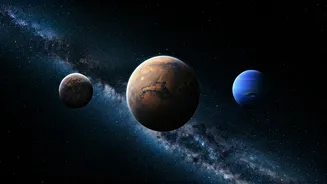
Sky enthusiasts in India are in for a treat with a remarkable astronomical occurrence: a rare alignment of four planets—Mercury, Mars, Saturn, and Neptune—will
be visible in the early morning sky. This captivating event provides a fleeting yet spectacular opportunity to observe multiple celestial bodies clustered together. The alignment is set to be observable across India from April 16th through April 23rd, offering a limited window for dedicated stargazers. To catch this display, individuals will need to be prepared to rise before the sun and scan the eastern horizon, provided local weather conditions permit a clear view. This celestial lineup is a unique chance to connect with the vastness of our solar system from your own backyard.
Decoding Planetary Alignment
A planetary alignment, from our perspective on Earth, occurs when several planets appear to converge within the same general area of the sky. It's crucial to understand that this visual proximity is an illusion; the planets themselves remain vast distances apart, separated by millions of kilometers. The reason they seem to line up is due to their orbits around the Sun. All planets travel along a similar, relatively flat plane known as the ecliptic. When viewed from Earth, which is also on this plane, these orbital paths can make the planets appear as if they are arranged in a celestial procession, offering a striking visual effect for terrestrial observers.
Viewing in India
The upcoming planetary alignment will be a visible spectacle across numerous regions globally, including India. For viewers in India, the prime time to witness this astronomical marvel will be in the period leading up to sunrise, specifically about 30 minutes before dawn breaks. This translates to looking towards the eastern horizon between approximately 5:00 AM and 5:45 AM, with the exact timing varying slightly based on your specific location within the country. It is highly recommended to find a viewing spot that is free from obstructions like tall buildings and minimal artificial light pollution to enhance your chances of spotting the planets. The most opportune days for observing this formation are predicted to be between April 18th and April 20th, when the planets are expected to present a more defined and visible arrangement in the sky.
What to Spot
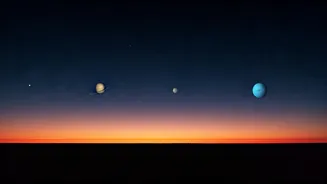
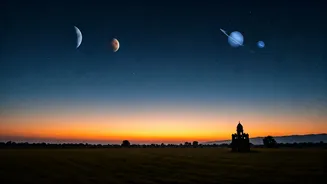
During this celestial event, the four planets will be positioned at varying heights above the horizon, appearing in a discernible row. Mercury, being closest to the Sun, will likely be situated very near the horizon and could be challenging to spot due to the approaching sunlight; its visibility is expected to improve in the days leading up to April 20th. Just above Mercury, you should find Saturn, recognizable by its gentle yellowish hue, which is visible to the naked eye, though binoculars can certainly enhance the viewing experience. Mars will be more conspicuous with its distinct reddish-orange color, appearing higher in the sky and thus easier to identify. Neptune, the most distant of the group, will be the faintest and will likely require binoculars or a small telescope for proper observation, as it is not readily visible without optical aid.
A Dynamic Display
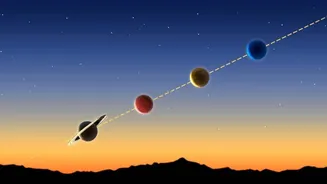
What makes this particular alignment exceptionally intriguing is the dynamic nature of the planets' arrangement over the viewing period. Initially, the planets might appear to form a somewhat triangular configuration in the sky. However, as the days progress, particularly by April 20th, their positions will begin to shift, transitioning towards a more diagonal line. This visual evolution offers skywatchers a unique opportunity to observe and appreciate how the relative positions of celestial bodies change over a short span of time, providing a tangible sense of cosmic motion and celestial mechanics.
A Fleeting Opportunity
Alignments of this nature, featuring multiple planets in such a clear and compact formation, are infrequent occurrences. While groupings of three planets are observed more regularly, the simultaneous presence of four planets in the same sector of the sky is a genuinely rare astronomical event. For individuals motivated to wake up in the early hours, this week-long celestial display presents a straightforward yet profoundly memorable method to engage with the night sky. The beauty of this event lies in its accessibility; for most of the planets involved, no specialized astronomical equipment is necessary, making it an inclusive experience for all who are curious about the cosmos.