








The 'Air Vacuum' Concept
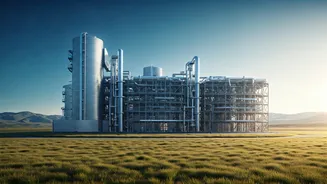
General Electric, a company long associated with powerful vacuums, is re-entering the arena with a revolutionary concept: direct air capture (DAC). This
technology employs sophisticated chemical processes to isolate and extract carbon dioxide molecules from the ambient air. The fundamental principle involves passing air over specialized chemicals that have a high affinity for CO2, effectively trapping it while allowing other atmospheric gases to flow through unimpeded. Once saturated, these chemicals are treated, typically with heat, to release the captured carbon dioxide. This concentrated CO2 can then be permanently stored deep underground in geological formations, preventing its re-entry into the atmosphere, or it can be ingeniously repurposed for long-term carbon sequestration in products like concrete and plastics. GE has successfully conducted initial tests on its DAC prototype and is gearing up for more extensive demonstrations in 2024, aiming to prove the scalability of this crucial climate solution.
Why We Need DAC
The concentration of carbon dioxide in our atmosphere has surged dramatically since the dawn of the Industrial Age, with a staggering half of this increase occurring since 1980 alone. While transitioning to renewable energy sources like solar and wind power, and adopting electric vehicles are essential steps in curbing new emissions, these measures alone are insufficient to address the existing atmospheric CO2 burden. Even natural carbon sinks, such as forests, are struggling to keep pace. Reforestation efforts are vital, but they too are not enough to counteract the immense volume of pollution. Direct air capture presents a complementary and indispensable solution, offering a technological means to actively remove legacy carbon from the atmosphere. Unlike strategies that require vast tracts of land, such as reforestation, DAC systems are relatively compact and can be deployed in a wider variety of locations, presenting fewer logistical constraints for widespread implementation.
GE's Scalability Advantage
The direct air capture landscape is currently populated by a mix of innovative startups and established energy companies. However, a player of General Electric's magnitude possesses a distinct advantage: the potential for rapid and massive scaling. David Moore, a senior official overseeing carbon management at GE, has emphasized the company's unparalleled ability to "scale and scale rapidly." This is rooted in GE's core expertise, which he describes as being "arguably the best company in the world, at least one of the best companies in the world when it comes to moving large quantities of air." This inherent capability in large-scale air handling is directly transferable to DAC technology. While it remains to be seen if GE's efforts will achieve the same household recognition as its traditional vacuum cleaners, the company's entry into the DAC space significantly bolsters the prospects for this technology to mature and make a tangible impact on atmospheric carbon levels.