
What are Nebulae?
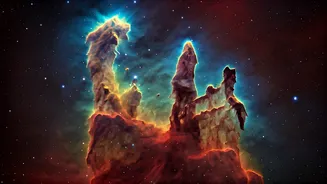
Nebulae, derived from the Latin word for 'clouds,' are immense cosmic structures primarily composed of gas and dust. They are primarily found within galaxies,
serving as the stellar nurseries where new stars are born or the remnants of dying stars. Their visual appeal is extraordinary, as light interacts with the gas and dust, producing a spectrum of vibrant colors, from the fiery reds of hydrogen to the cool blues of oxygen. Nebulae come in many forms, each with unique characteristics and tales to tell about the cosmos. These structures are not just pretty pictures; they are a treasure trove of information, providing insights into star formation, galactic evolution, and the chemical composition of the universe. The study of nebulae offers essential information to astronomers. Nebulae are an important reminder of the scale and magnificence of the cosmos, with each one containing a story written across light-years.
Nebulae and Starbirth
Nebulae serve as the birthplaces of stars, undergoing a process that starts when gravity causes a nebula to collapse. Within these dense clouds, pockets of gas and dust begin to coalesce, forming protostars. As the protostar accumulates more material, it heats up, eventually igniting nuclear fusion in its core, marking the birth of a new star. This process is complex, involving the interactions of gravity, radiation, and magnetic fields, all influencing the formation and evolution of stars. The Orion Nebula is a vivid example of a stellar nursery, teeming with young stars. The study of nebulae helps scientists understand the mechanisms of star formation and provides key information about the early stages of a star's life. The environment within a nebula is also critical in determining the properties of the stars that are born there. The density, temperature, and composition of the gas and dust influence the mass, luminosity, and even the presence of planets around the newly formed stars.
Nebulae's Stunning Forms
Nebulae exhibit a spectacular array of shapes, colors, and sizes. This variety stems from the different processes that shape them. Emission nebulae, such as the Orion Nebula, glow due to the energy released by nearby young, hot stars. These stars ionize the surrounding gas, causing it to emit light. Reflection nebulae, like those found around the Pleiades star cluster, scatter the light from nearby stars, appearing blue. Dark nebulae are clouds of dense dust that obscure the light from stars behind them, appearing as dark patches against a brighter background. Planetary nebulae, formed from the outer layers of dying stars, display complex shapes and structures, often with intricate rings and shells. Each type of nebula offers a unique perspective on the cosmos and the processes that shape it. The colors seen in nebulae are primarily due to the emission of light by different elements. Red represents hydrogen, green indicates oxygen, and blue denotes oxygen. The distribution of these elements within a nebula provides insights into its composition and the conditions that exist within it.
Significance to Science
Nebulae are important astronomical laboratories and offer valuable insights into many aspects of the universe. Astronomers study nebulae to understand stellar evolution, the formation of stars, and the chemical composition of galaxies. Through the analysis of nebulae, scientists can trace the lifecycle of stars, from their birth within a nebula to their eventual death. Analyzing the light emitted by nebulae allows astronomers to determine their composition, temperature, and density. This information is crucial for understanding the processes of star formation and galactic evolution. Additionally, nebulae offer clues about the origin and distribution of elements in the universe, as the material in nebulae is enriched by the elements created by dying stars. Nebulae help in understanding the interstellar medium, providing information about the gas and dust that fills the space between stars. The study of nebulae is an active field of research, with new discoveries constantly being made.
Explore and Observe
Observing nebulae can be an exciting experience for amateur astronomers. Although many nebulae are too faint to be seen with the naked eye, a telescope with a moderate aperture can reveal their beauty. Key targets for observation include the Orion Nebula, visible even with small telescopes, and the Lagoon Nebula, located in the constellation Sagittarius. To enhance the viewing experience, it is essential to use dark locations, away from light pollution. Using nebula filters can further improve the visibility of these celestial objects by blocking out unwanted light wavelengths. When stargazing, patience and persistence are key, as it takes time for your eyes to adjust to the darkness and for the details of the nebulae to become visible. Joining a local astronomy club can also provide helpful resources and guidance. With the right equipment and a little practice, anyone can appreciate the breathtaking beauty of nebulae. These cosmic clouds are reminders of the vastness and mystery of the universe.