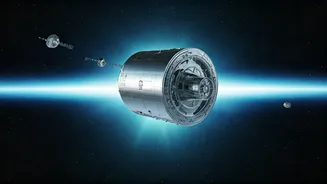

Prelude Mission Unveiled
The European Space Agency (ESA) and ClearSpace revealed plans for the PRELUDE mission. This initiative is designed for in-orbit servicing and debris removal,
representing a crucial step towards mitigating space debris and ensuring the long-term sustainability of space activities. The PRELUDE mission is a collaborative effort aimed at addressing the increasing issue of space debris. By focusing on in-orbit servicing and removal, the mission seeks to extend the operational life of existing satellites and clear defunct ones, ultimately reducing the risk of collisions and creating a cleaner space environment. This proactive approach underscores the commitment of ESA and ClearSpace to preserving the space environment for future generations of space explorers and satellite operators.
Autonomous Space Operations
Turion Space Corp. has acquired Tychee Research Group. This strategic move aims to accelerate developments in autonomous space operations and mission engineering. The acquisition is expected to bolster Turion Space Corp.'s capabilities in designing and executing complex space missions. It focuses on incorporating advanced technologies, like artificial intelligence and machine learning, to enable satellites to make independent decisions, reducing reliance on ground control. This integration could significantly improve the efficiency and responsiveness of space missions. Furthermore, the collaboration is anticipated to pave the way for more efficient and cost-effective operations.
5G Tests in Orbit
Tyvak International's LIDE satellite successfully completed its initial on-orbit tests of 5G technology. These tests are significant as they indicate the potential for integrating advanced telecommunications systems in space. The successful implementation of 5G technologies in space could revolutionize how we communicate and transmit data from orbit. This innovation has the potential to improve connectivity for various applications, including remote sensing, scientific research, and global communication networks. With this achievement, it becomes easier to explore the possibilities of faster data transfer and enhanced communication capabilities in space, leading to new opportunities for space-based services.