





A Heavenly New Route
A remarkable 32-kilometer pathway carved through the stark beauty of the Rann of Kutch in Gujarat has garnered significant attention, not just as a logistical
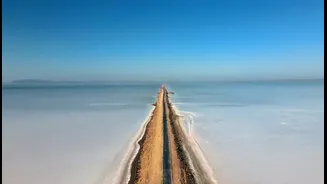
improvement but as an experience that evokes deep contemplation. This road, often referred to as the 'Road to Heaven,' has recently captured the imagination of industrialist Anand Mahindra, who shared his reflections on its profound tranquility. He noted its potential for silence and introspection, highlighting how a functional infrastructure project has evolved into a celebrated pilgrimage route. The visual spectacle of the Rann, with its endless salt flats meeting the azure waters of the Arabian Sea, creates a unique sensory engagement for those traversing this route, often accompanied by distant glimpses of local life, like cowherds tending to their animals.
Connecting Past and Present
This recently established 30-kilometer roadway, linking Khavda directly to Dholavira, signifies a major development in Kutch's connectivity. Previously, the journey from Bhuj to Dholavira spanned approximately 240 kilometers. The commissioning of this new route in 2019, with the specific 30km segment operationalized in 2024, drastically shortens travel time and enhances accessibility to Dholavira, a significant archaeological site. Dholavira, recognized as the largest Harappan Civilization relic in India and a UNESCO World Heritage Site, now presents an easier gateway for visitors eager to explore the remnants of this ancient, thriving city. This strategic road is part of a larger 278-kilometer national highway project connecting Ghaduli to Santalpur, with a particularly striking segment traversing the expansive White Desert.
An Ethereal Landscape
The journey along this remarkable stretch of highway is nothing short of surreal, offering a visual spectacle where the sky seems to melt into the waters. As the road cuts through the heart of the White Desert, travelers are greeted by the mesmerizing sight of the sky's reflection mirroring in the saline water bodies flanking the single-lane asphalt. This phenomenon is a testament to the Rann's geological history; once a shallow part of the Arabian Sea, geological shifts eventually sealed its connection. During the monsoon season, the Rann transforms into a vast expanse of water on the salty terrain, while the rest of the year it reverts to an endless salt desert. The unique vantage point allows visitors to step off the road, feel the gravel beneath their feet, and even dip their toes into the surrounding water, enhancing the immersive experience of this otherworldly environment. For those equipped with drones, the unobstructed horizons and reflective surfaces offer unparalleled opportunities for aerial photography.