


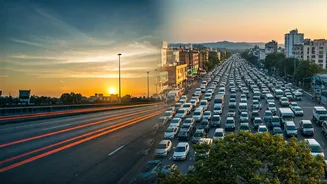


Swift Journey Unveiled
The recently inaugurated Delhi-Dehradun Expressway has dramatically reshaped the travel experience between the nation's capital and the serene city of
Dehradun. What was once a journey spanning approximately six hours has now been condensed into an impressive travel time of just 2 hours and 55 minutes, as confirmed by test drives conducted by the Uttarakhand Transport Corporation (UTC). This significant reduction prioritizes passenger convenience and speed, making the 'long drive' a thing of the past. The expressway is designed not merely for speed but also as a testament to modern engineering, facilitating speeds of up to 100 km/h across its expansive route.
Fare Reductions Announced
In tandem with the reduced travel time and anticipated lower fuel consumption, the UTC has implemented substantial fare reductions across its services. This makes travel not only faster but also more economical for all commuters. For premium Volvo services, the fare has dropped from Rs 945 to Rs 709, offering a saving of Rs 236. Travelers opting for AC class will now pay Rs 557, down from the previous Rs 704, equating to a saving of Rs 147. Even ordinary bus services have seen a decrease, with fares reduced from Rs 420 to Rs 355, resulting in a saving of Rs 65. These adjustments are designed to provide significant financial relief to tourists and regular commuters alike.
Engineering Marvel Features
The Delhi-Dehradun Expressway stands out as a remarkable feat of engineering, designed to accommodate high-speed travel. It spans a considerable length, featuring 6 to 12 lanes depending on the specific stretch. The route commences at Akshardham in Delhi and winds its way through Loni, Baghpat, Baraut, Shamli, and Saharanpur before reaching Dehradun. A key highlight is a 50.7 km side stretch that offers expedited access to Haridwar, reducing the travel time from Delhi to this pilgrimage city to just 2 hours. Furthermore, the project incorporates an extraordinary 12 km overhead bridge, recognized as the longest wildlife corridor in Asia, passing through the ecologically sensitive Rajaji National Park.