







A Cosmic Visitor
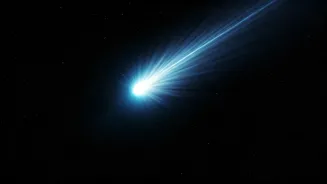
Interstellar comet 3I/ATLAS, unlike comets born within our solar system, originates from outside, making it a fascinating subject for study. Recent observations,
thanks to the collaborative efforts of the Hubble Space Telescope and the JUICE Jupiter probe, have offered stunning new insights into its nature. These powerful instruments have captured the comet's jet, a stream of gas and dust blasting away from the nucleus as it approaches the sun. The Hubble images, combined with data from the JUICE probe, provide a unique perspective on the comet's behavior, showing how it interacts with solar radiation and the space environment. This encounter offers scientists the opportunity to study a pristine sample of material from another star system, giving clues about the formation and evolution of planetary systems beyond our own.
Hubble's Observations
The Hubble Space Telescope, renowned for its exceptional clarity and ability to observe distant objects, played a crucial role in capturing the comet's details. The images reveal the growing tail of 3I/ATLAS, a visual testament to the comet's activity as it travels closer to the sun. The tail, formed by solar radiation and the solar wind, is composed of dust and gas particles. The continuous monitoring of the tail's development offers vital clues about the comet's composition and the rate at which it releases material. This data helps scientists understand the composition of 3I/ATLAS, comparing it to comets from our solar system. The high-resolution images also give insight into the nucleus, enabling astronomers to measure its size and shape.
JUICE's Contribution
The JUICE (Jupiter Icy Moons Explorer) probe, designed to study Jupiter and its icy moons, also provided valuable data on the comet. Although not its primary target, JUICE captured images and collected data on 3I/ATLAS, complementing the Hubble observations. This multi-platform approach, leveraging different instruments and perspectives, strengthens the scientific value of the studies. While the Hubble images offered superior resolution, JUICE added crucial spectral data by analyzing the light from the comet's tail. This spectral analysis is key to identifying the various gases and particles present, revealing the comet's chemical composition and allowing comparisons with comets from our solar system. Together, Hubble and JUICE offer a comprehensive portrait of 3I/ATLAS, highlighting its behavior and providing a rich dataset for further research.
Comet's Unique Nature
Interstellar comets, like 3I/ATLAS, represent a rare opportunity to study objects originating from outside our solar system. Their composition and behavior differ from comets originating within our planetary system. The study of 3I/ATLAS provides a chance to understand the conditions that may have existed in other star systems and offers potential insights into the formation processes of planets elsewhere. The comet's journey through our solar system provides a unique opportunity for scientists to study how interstellar objects interact with the Sun and its environment. As 3I/ATLAS continues its journey through space, future observations are expected to reveal even more details. This data can allow scientists to improve their understanding of comets and the role they play in distributing essential elements throughout space.
Future Research
Scientists continue to analyze the data gathered from the Hubble Space Telescope and JUICE probe, seeking to learn even more about 3I/ATLAS. Future research will focus on the comet's nucleus, its composition, and its interaction with the solar wind. They're also examining the tail's structure and its variability as the comet moves through space. The images and data collected will be compared to comets in our solar system, looking for similarities and differences that can reveal important information about the formation and evolution of both types of celestial bodies. Furthermore, these findings will be used to enhance models of comet activity and understand the frequency of interstellar comets and their possible role in delivering water and organic compounds to planetary systems. This will contribute to our understanding of the universe.