







Founding Principles Clash
The heart of this legal dispute lies in the divergence of OpenAI's trajectory from its inception. Established in 2015, the organization was envisioned
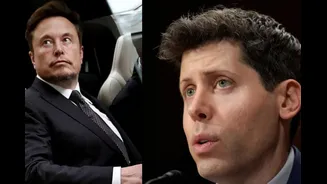
by tech luminaries like Elon Musk and Sam Altman as a nonprofit entity dedicated to developing artificial general intelligence (AGI) for the collective good of humanity. The founders' initial intent was to prevent any single entity, like Google which held a significant AI lead at the time, from dictating the future impact of AGI on the human race. A cornerstone of this early vision was the commitment to openly sharing AI advancements with the public as open-source software, fostering a collaborative approach to this transformative technology. However, as the years progressed, a shift in perspective began to emerge within OpenAI. A segment of its leadership, including Musk himself, started to voice concerns that completely open-sourcing powerful AI could pose significant risks. Concurrently, doubts arose about OpenAI's ability to secure the substantial funding necessary to achieve its ambitious AGI objectives. Musk even proposed a partnership with Tesla to leverage its supercomputing infrastructure for AI development. This divergence in strategic thinking ultimately led to friction, with Musk eventually stepping down from OpenAI's board and withdrawing his financial backing, subsequently pursuing his own AI ventures. This foundational period and the subsequent disagreements set the stage for the current legal confrontation.
Musk's Allegations Detailed
Elon Musk's lawsuit against OpenAI, filed in 2024, centers on a fundamental accusation: that the organization, under the leadership of Sam Altman and other executives, has deliberately strayed from its humanitarian mission in pursuit of financial gain. Musk contends that he was intentionally misled by Altman and Greg Brockman, OpenAI's president and a co-founder, who allegedly made false promises regarding a commitment to a safer, non-profit-driven path for AI development, distinct from profit-hungry giants like Google and Microsoft. The discovery process in the trial has brought to light a series of internal documents, including diary entries by Brockman, that appear to corroborate Musk's claims. These entries suggest internal discussions and potential doubts about adhering strictly to a non-profit-only model. For instance, one entry reportedly expresses a reluctance to be committed to the non-profit structure if a 'b-corp' (benefit corporation) structure was adopted later, implying a potential for future profit-seeking. Brockman also indicated a personal aspiration to become a billionaire. Musk's legal team argues that these documents demonstrate a pre-existing plan within OpenAI's leadership to transition to a for-profit model long before it was publicly disclosed, and that he and other early stakeholders were deliberately kept in the dark. These very diary entries were instrumental in Judge Yvonne Gonzalez Rogers' decision to allow the case to proceed to trial, indicating that Musk had presented sufficient evidence of being misled.
OpenAI's Defense Strategy
OpenAI's counter-argument hinges on the assertion that Elon Musk himself was the one who initially sought to transform the nonprofit lab into a commercial enterprise before his departure in 2018. Evidence presented in the case suggests that in 2017, Jared Birchall, who managed Musk's family office, registered a company named 'Open Artificial Intelligence Technologies.' This entity was apparently intended to function as a for-profit counterpart to OpenAI. In its court filings, OpenAI has stated, 'His own words and actions speak for themselves. Elon not only wanted, but actually created, a for-profit as OpenAI’s proposed new structure.' Furthermore, OpenAI has contended in a blog post titled 'The truth Elon left out,' published on January 16, 2026, that Musk expressed a desire to amass $80 billion for a self-sustaining Mars city and demanded majority equity and full control over AI development due to past experiences. They also state that he proposed his children should control AGI during succession discussions, surprising the leadership. OpenAI also accuses Musk of actively attempting to hinder its progress while simultaneously advancing his own competing AI initiatives. For context, OpenAI currently operates as a for-profit public benefit corporation (PBC) under the oversight of its charitable arm, which is a significant shareholder. Although the company initially proposed to eliminate the nonprofit's oversight, it later rescinded this idea following criticism from advocacy groups.
Trial Expectations & Outcomes
The resolution of Elon Musk's claims against OpenAI will be determined by a nine-person jury. It is important to note that on Friday, April 24, Judge Rogers dismissed Musk's fraud claims, meaning the trial will proceed solely on the allegations of breach of charitable trust and unjust enrichment. Should the court rule in favor of Musk, he is reportedly seeking $150 billion in damages, with the proceeds designated for OpenAI's charitable arm. His lawyer, Marc Toberoff, stated that Musk is asking the court to reclaim assets diverted from a public charity and prevent those responsible from repeating such actions. Additionally, Musk has requested that Altman be removed from OpenAI's board and that the company reverse its recent transition to a for-profit PBC. If these remedies are granted, it could significantly impact OpenAI's operations and its potential for a major initial public offering, while also presenting a substantial advantage to competitors like Anthropic and Google. Conversely, a loss for Musk would permit OpenAI to operate freely as a for-profit entity, enabling it to pursue extensive data center expansion projects potentially costing hundreds of billions. The company has already grown to employ over 4,000 individuals globally, including in India. Judge Rogers highlighted that the trial's outcome depends on the jury's belief in the credibility of the testifying individuals.