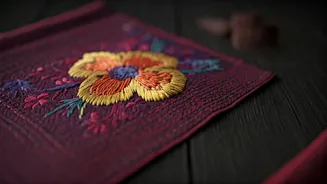







A Stitch Awakens
Shamlu Dudeja's fascination with Kantha began unexpectedly at a crafts fair, where a humble running stitch evoked cherished memories of her school days
and her mother. This initial encounter, sparked by three silk saris she tea-dyed and entrusted to local women for embroidery, marked the genesis of a profound movement. Initially unaware of the craft's name, she was captivated by its intricate beauty and deeply affected by the artisans' living conditions. Her subsequent visits and the return of the exquisitely embroidered saris garnered immense admiration from friends and family across India and even London. This widespread curiosity outside Bengal was the catalyst for a remarkable journey, setting in motion an endeavor that would not only revive Kantha but also provide significant financial empowerment to countless women, a testament to her unscripted beginnings and evolving vision.
Decades of Growth
Over the past 37 years, the initiative spearheaded by Shamlu Dudeja has blossomed from a small, personal passion into a structured force for empowerment. What began organically, without predefined social work objectives, has evolved into a comprehensive program that champions both the revival of the Kantha craft and the financial independence of women. Documented by Harvard Business School, SHE Kantha has expanded its reach dramatically, now encompassing over 1,200 artisans, many hailing from remote villages. The core mission centers on enhancing income, fostering agency, instilling dignity, and cultivating valuable skills. Dudeja's personal commitment, often funded by her own savings, involved extensive travel across India and internationally to France, Japan, the US, and the UK, diligently building a global appreciation for Kantha. Complementing this, her Calcutta Foundation offers broader training in stitching, digital literacy, and livelihood development across 22 centers, solidifying her pioneering role and inspiring thousands.
Innovating Traditions
The future of Kantha is being shaped by exciting new directions, blending tradition with contemporary aesthetics. Shamlu Dudeja's venture into SHE Art aims to promote Kantha as wall art, featuring large, intricate pieces that can take years to complete. Simultaneously, the focus is on fashion innovation, incorporating Kantha with aari and beadwork to create modern occasion wear, including stoles and shirts with contemporary silhouettes. This evolution is further propelled by the fresh perspectives of her granddaughters, Mahima and Saumya, fostering collaborations with young designers while steadfastly upholding high standards of craftsmanship and fair compensation. Encouragingly, younger audiences are showing keen interest, particularly in versatile Kantha jackets, prompting an expansion into such accessible formats. The exploration of geometric patterns for diverse markets, both domestically and internationally, alongside a continuing commitment to traditional Kantha revival, highlights a dynamic approach to design.
Artistry and Impact
The core ethos of the work remains the empowerment of women, coupled with a relentless pursuit of expanding reach and maintaining exceptional quality. The inherent challenge lies in the handcrafted nature of each piece, precluding mass production. However, the true fulfillment is evident in the profound impact on the artisans' lives; women are now able to support their children's education and make independent decisions, a direct result of their involvement. They receive payments directly, benefiting from the flexibility to work at their own pace. Today, operations span 30 locations across West Bengal, serving a global clientele. The intricate stitches and vibrant narratives woven into every Kantha piece are more than just decorative elements; they are visual stories reflecting rural life, mythology, and everyday experiences, transforming textiles into significant works of art brimming with cultural depth. Dudeja's steadfast dedication has fundamentally altered the lives of many women, granting them a voice and a sustainable livelihood through their artistic talents.