






Trade Deal's Impact
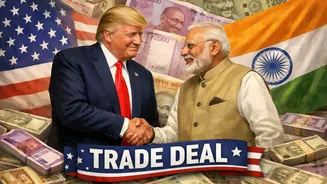
The recently finalized trade agreement with the United States is poised to significantly impact the Indian stock market. This deal is seen as a key factor
in removing the obstacles that had previously led to record outflows of foreign investment. Moreover, the valuation of Indian assets compared to other Asian markets has declined to its lowest level in nearly five years, largely due to apprehensions regarding tariffs and a slowdown in earnings. The trade deal's conclusion comes after the announcement of the budget. It offered support to exporters and industries, boosting investor confidence. Market analysts, such as Jefferies Financial Group Inc., anticipate the agreement, combined with other trade deals with the EU and the UK, will lead to a positive shift in foreign investor sentiment towards India. This shift is expected to strengthen the Indian rupee in the near term and attract foreign portfolio investments.
Investor Sentiment Shifts
The trade deal is viewed as a crucial catalyst for reversing negative investor sentiment towards Indian assets, which, according to Arvind Chari of Q India UK, could lead to a reversal of India's underperformance compared to other emerging markets. The past year saw global investors withdrawing $3.2 billion from local stocks. This follows a substantial outflow of $18.8 billion in the preceding year. India's performance lagged behind its emerging market peers, resulting in India's weight in the MSCI Emerging Markets Index dropping below South Korea's in January, for the first time since December 2021. However, some challenges persist. Mixed earnings reports this season and the need for clarity on India's commitment to purchase $500 billion of goods from the US as part of the deal are concerns. At the same time, the scope for further monetary easing is shrinking, with economists anticipating the central bank will hold rates.
Market Reactions & Outlook
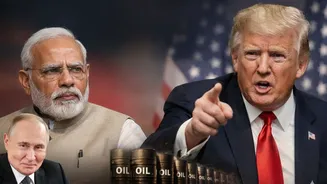
Following the trade announcement, Nifty 50 futures traded at GIFT City surged as much as 4.5% overnight, signalling strong optimism ahead of trading. Cash equities also showed early signs of recovery, with the NSE Nifty 50 Index rising by 1.1%, marking its largest gain in over two months, even as several Asian markets experienced a broader selloff. This increase indicated that investors are looking past concerns about a proposed tax hike on equity derivatives and a sharp drop in metal prices that had affected risk assets globally. The specific details of the US-India trade agreement include the US agreeing to reduce tariffs on Indian goods from 25% to 18%, and eliminating an additional 25% duty linked to the purchase of Russian crude oil. These developments are viewed as positive for the Indian currency and the overall investment climate.
Experts' Perspectives
Market analysts and investment strategists are optimistic about the implications of the US-India trade deal. Michael Brown of Pepperstone Group notes that the agreement appears favourable, while acknowledging questions about the realization of the $500 billion purchase commitments. A. Balasubramanian of Aditya Birla Sun Life AMC Ltd. stated the deal, immediately following the budget announcement, could lead to a reversal of foreign outflows and a rally in the Indian currency. He also estimates that approximately $100 billion of investment was waiting to enter India in the next two to three years, pending the settlement of the tariff issues with the US. This influx of capital could further strengthen the market and boost investor confidence, paving the way for sustained growth.